


I just completed a migration from Substack back to my own website, using Ghost as the backend CMS. Like any move, it was a pain in the ass.
I am not writing this to talk about the move, because frankly, why would anybody care? I am writing this because this one experience was a window into our terrifying and thrilling future that is not as far off as one might think.
The future is thrilling because of the incredible expansion of capability, of power, of possibilities. It is terrifying because what that implies for our society, our economy, and our civilization. I do not believe this is pure hype anymore. Both the thrill and the terror are justified.
This one tiny experience by one blogger shows us why. I thought I would tell that story to the best-informed audience in real estate. This will be a public post to celebrate the new (old) home of Notorious ROB, and because I think the topic and the issues are of broad interest and importance.
The Past is Prologue
It might make sense to touch a bit on the past, because it contextualizes the present.
I began Notorious ROB in 2009, after freeing myself from corporate jobs where the company required that all of my posts be reviewed by Legal and Communications departments.

Like so many, I started on Wordpress. It simply was the best website platform at the time, which many have used to do things like build brokerage websites and e-commerce sites. It was powerful, flexible, customizable... and complicated.
The entire time I was on Wordpress, I hired someone to help me manage it because Wordpress might be easy for a real tech guy to manage but it was far beyond my meager abilities. I had a "webmaster" the entire time I was on Wordpress.
Substack simplified things but removed the flexibility. If all you want to do is write a newsletter with a paid option, then Substack is great. If you want to try anything else, it's really restrictive.
Which brings us to today. I moved off Substack and onto Ghost because I want more control, more customization, more flexibility.
Ghost, Wordpress and the Open Platform
You can go read up on Ghost if you'd like. At its heart, Ghost is a CMS that does what I needed Substack to do. But it offers something that Substack couldn't: control.
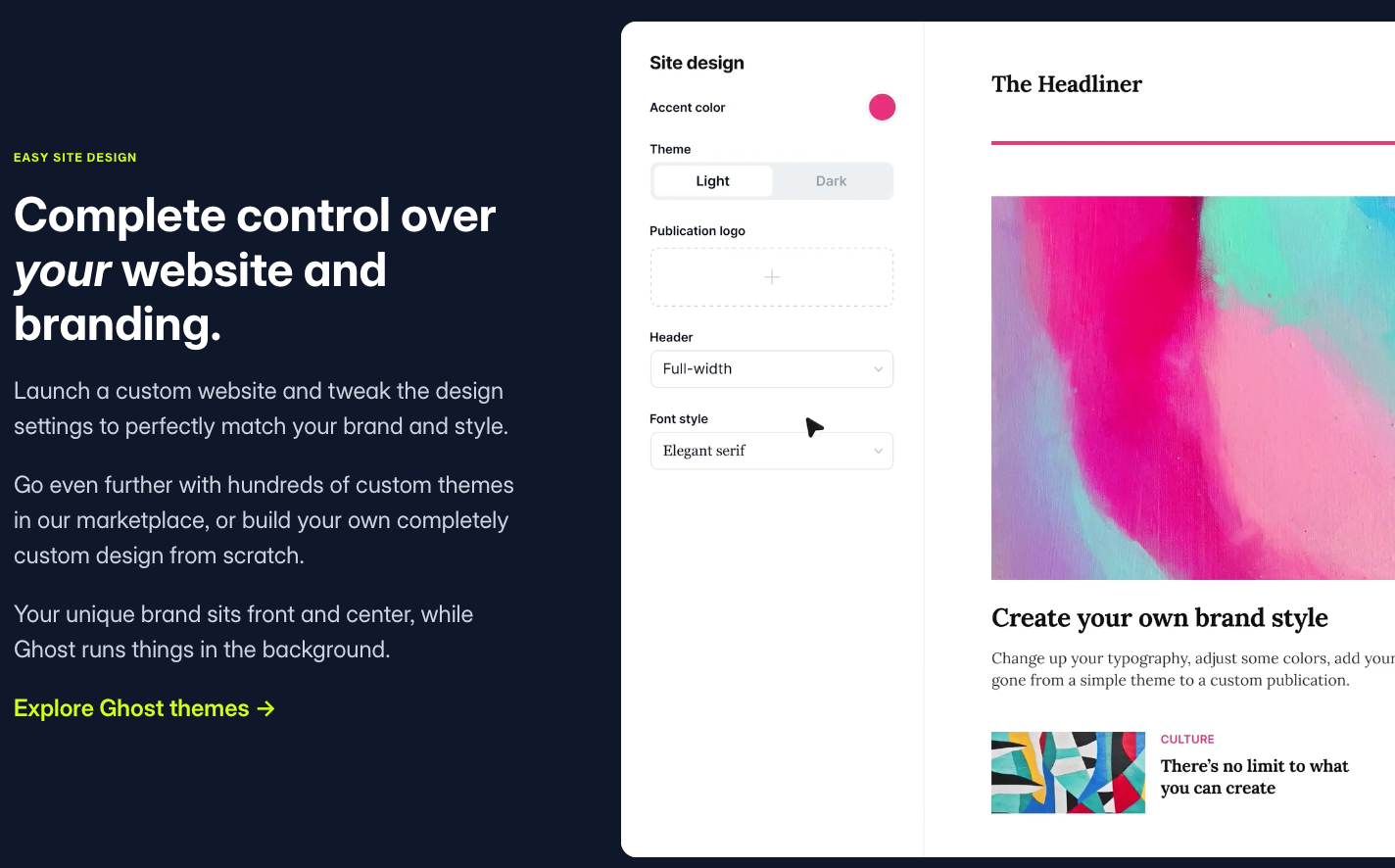
The look and feel of this website that you are reading right now is almost fully custom; I created it.
Well, that is... I created it with Claude.
What's more, Ghost has API access, and it is simple to integrate with a variety of other tools I might want. It is an open platform.
Wordpress also is an open platform, but the technology and the architecture are super dated. Because Wordpress has millions of users, thousands upon thousands of plugins, a full ecosystem that relies on its core technology, it simply has to move slowly, carefully. Wordpress cannot innovate, because of the burden of legacy.
The Thrill
If the story ended there, there would be no reason to write this. A blogger went from Substack to something else with more flexibility. Whoop de doo. Who gives a damn?
What I found during the migration is that as open as Ghost is, as flexible as it is, it still isn't as open and flexible as I want it to be.
Just to use one example, if you signed into Notorious ROB to read this post, you got a "magic link" email. Ghost doesn't believe in username/password, because that is inherently less secure. If this were a bank website, maybe that makes sense. This is a blog. Yet, I can't enable username/password, or the wide panoply of so-called "social logins" like using Google to login. You've seen them all over the internet.
I can't enable any of that, because I am on Ghost(Pro), the hosted version of Ghost that is meant to take all of the technology burdens off of me so I can concentrate on writing and running this little blog. It makes a ton of sense for people like me who have zero technical skills and need smart tech guys to manage the platform for me.
And yet.
It turns out that Ghost is a fully open source project. It can be self-hosted, if you have the stomach for that sort of thing. Ghost themselves say this:
It depends on what you’re looking for. Self hosting is usually cheaper than hosting with Pro, but it comes at the cost of having to manage updating Ghost, and not having access to Ghost Support if you need help. Hosting with Pro has the limitation of not having direct access to your Ghost instance, so if you need to make changes for whatever reason, it’s not possible (though most users don’t need to make changes).
That being said, if you’re just looking to blog, I would suggest Ghost Pro, but if you’re okay with spending the time to manage your instance, or if you can’t afford the Pro pricing, self hosting is your solution.
It's not about Pro pricing. It's about having more control.
Three months ago, I would have stopped right there. Well, I can't enable social login, because the platform I am using doesn't have it. I'll learn to live with it. It's not like I'm going to get involved in managing updates, security, and what the hell is a Ghost instance anyhow?
Today?
The Power is Real
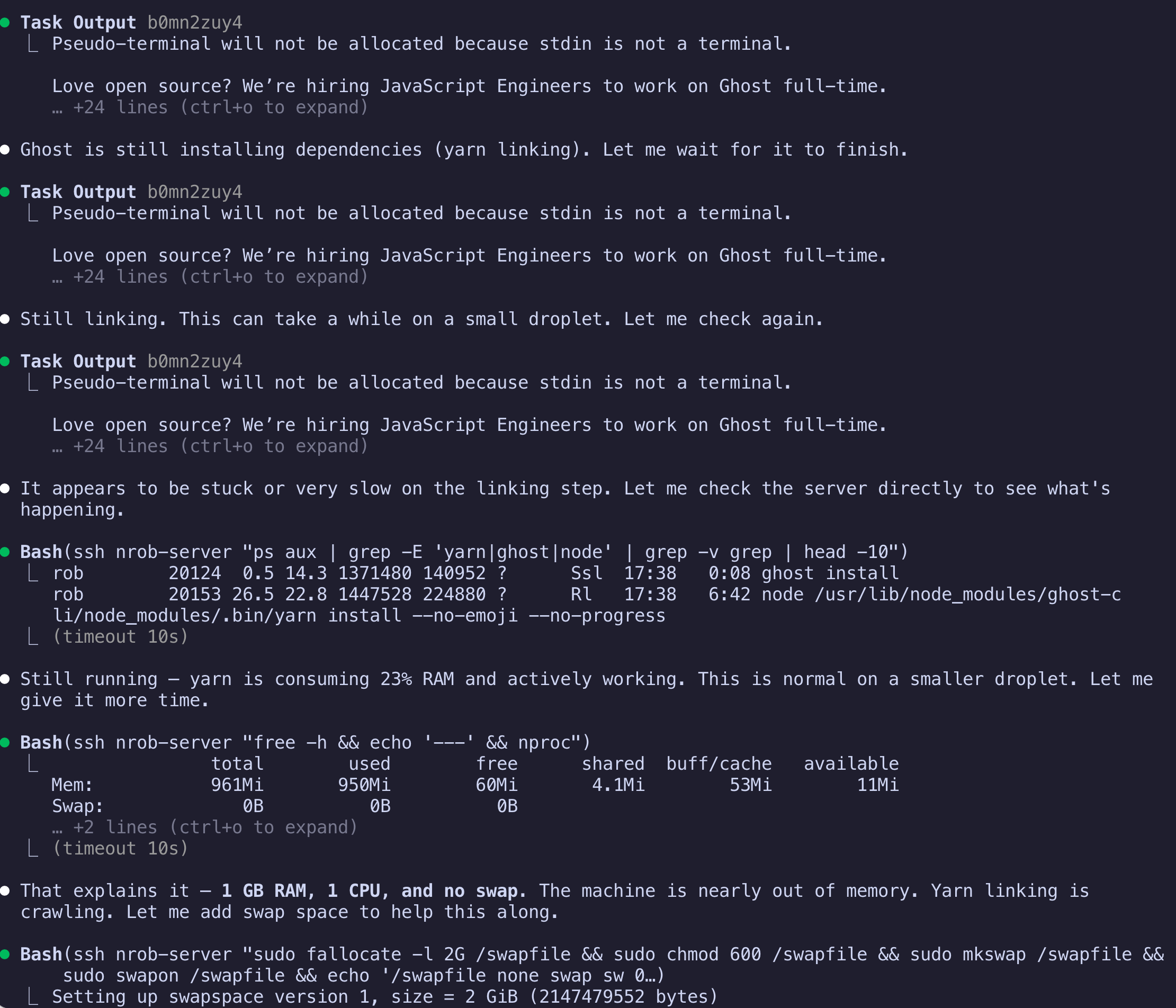
This is my terminal running Claude Code installing Ghost onto my own server. I know that this looks like Babylonian cuneiform to most of you, because that's what it looks like to me. Except when Claude speaks plain English back to me. If you care to read the above, you'll see that Claude noticed that the install was going very slowly, checked the server specs to find out that it's tiny (1GB RAM, 1 CPU) and decided to fix that proactively by giving it "swap space" (whatever that means).
WTAF? 🤯
As I write this post, I am installing and configuring my own version of Ghost. That I can control fully. Because it is open source, I can in fact enable social logins for you all. I can change anything in the platform that I want.
Yes, this means I will need to take on the responsibility for managing it: the security, the updates, the instance-whatever-that-is. I am clearly unqualified and incapable of doing any of that.
But I have help. I have an AI that is fully capable of managing the server, configuring Ghost, doing security, doing the updates, doing whatever needs doing in the instance-whatever-that-is.
Claude can and will be my "webmaster" as far as I can tell. Claude can and will be my engineer. Is it capable of building out some mission-critical software that billion dollar companies will rely on? I have no idea. But I'm just operating a blog and newsletter. I think Claude will do.
This is the thrill. I have capabilities that I don't actually have. I have power that I don't actually have. Because I have this tool that gives me those capabilities and that power.
Actually, that's a misstatement. And therein lies the seeds of terror. I don't have a tool that gives me capabilities and power. I have an employee that does.
I do not use Claude the way a programmer might, as a tool. I use Claude the way I used to use my webmaster: I tell it what I want done, and wait for it to do it. I haven't the faintest idea how it does it; I hadn't the faintest idea what my webmaster did to fix whatever was broken in my Wordpress site either. That's not a tool; that's an employee or a contractor.
The Terror
The debate and discussion around AI today is about this exact phenomenon. AI is coming for your job!
Fortune for example, ran this story recently:
Tech titans and stock market investors are increasingly unified in their forecast that artificial intelligence will permanently eliminate millions of white-collar jobs and render traditional employment obsolete.
Software and services stocks have taken a beating, with software multiples pulling back by roughly 33% since late 2025 as investors fret over AI’s potential to automate vast swaths of knowledge work. Earlier this year, Elon Musk predicted that AI and humanoid robots will make work completely “optional” within the next 10 to 20 years, ushering in a post-scarcity economy where money itself becomes irrelevant. He joins a growing chorus of tech executives issuing stark warnings about human obsolescence; OpenAI CEO Sam Altman recently cautioned that superintelligence could soon outperform even top corporate executives, while Microsoft AI chief Mustafa Suleyman and Anthropic CEO Dario Amodei have projected that sweeping white-collar automation could arrive in one to five years. Economists remain skeptical of the timeline, noting that the apocalyptic narrative may be as much a tool to justify astronomical tech valuations as it is an impending economic reality.
But a new, cross-asset research report from Morgan Stanley offers a remarkably grounding message for anxious employees and jittery markets: Most of you won’t be permanently unemployed; you are just going to find new jobs, many or most of which don’t exist yet.
I don't quite know how reassuring it is to tell 45 year olds that they'll just have to find new jobs that require retraining and which don't exist yet. But it is at least a positive spin on things.
To be honest, as someone who has been unemployed since 2009 or so... because "consultant" is just another way to say "unemployed"... the news that AI is coming for my job doesn't scare me. So why the terror?
Because I work in the real estate industry, which is inherently connected to the housing industry. Being in that industry, we cannot help but be deeply connected to both the real world (bricks, wood and mortar) and the financial world (mortgages). Economic shocks and transitions and monetary policy and AI tech and so on and so on are mostly interesting to policymakers and priests of high finance. But we in real estate see the impact on the ground perhaps sooner or more up-close-and-personal than the people on Wall Street and in the DC Swamp.
From that context, watch this video. Skip to about 35 minute mark, because the first half is macro finance. The real shit starts around the 40 minute mark.
What makes Luke Gromen special, and why he's my favorite macro analyst, is that he lives in the Rust Belt. He has seen firsthand the impact of the outsourcing of manufacturing to China and elsewhere not just on corporate balance sheets, but in the lives of actual human beings on the ground, in the towns and counties and cities in the Rust Belt.
When he says that the AI productivity boom is functionally the same thing as Chinese workers making things for a fraction of the cost... and points out the impact on the working class... suicide, alcoholism, deaths of despair, broken and destroyed marriages and families... and concludes that what outsourcing did to blue collar Americans, AI will do to white collar Americans...
I don't know how you avoid terror.
The Real Estate Perspective
For those of us in real estate, who have seen the Real Estate Bubble collapse and the ensuing Great Financial Crisis... the terror is acute.
Because Gromen is absolutely 100% correct that we don't need to see 80% of white collar jobs disappear to have systemic collapse. Let just say only 10% of white collar jobs disappear because of AI over the next... two years? Three?
The best assumptions (thanks Claude - see what I mean?) I can make is that there are roughly 22.6 million workers in "professional and business services" like accounting, law, management, coding, etc. The whole "white collar" category including things like administrative services, healthcare administration, etc. is more like 60 million workers.
They are going to be college-educated high-income people. More of them are going to be homeowners than blue collar workers. More of them are the aspirational homebuyers than Amazon warehouse workers are. Let's assume that 75% of white collar workers are homeowners, vs. the national average of 65.7%. That feels conservative to me, but let's go with it for now.
At 22.6 million, 10% loss means 2.3 million jobs vanishing; at 60 million, it's 6 million jobs.
Until these new AI jobs appear, and those people start earning what they were before (which may never happen), we're talking about 1.725 million or 4.5 million mortgages going into distress.
As a reminder to those of you in real estate who came into the industry after the Bubble, the entire crisis of the late 2000s began with a few hundred thousand subprime mortgages defaulting sometime in early 2007. How will a few hundred thousand prime mortgages defaulting cascade?
Three things to inspire more terror:
- That is assuming 10% white collar job loss; make it 20% and double the numbers. Make it 30%. It seems weird to think that AI would only replace the bottom 10% of white collar workers, those who add the least value.
- The Bubble involved subprime loans, NINJA loans, and widespread fraud. The mortgages we're talking about here are the most rock-solid mortgages to high-earners with real assets and 780 FICO scores. If those go delinquent....
- In the GFC, the government bailed out the banks. The government had programs for distressed homeowners. As Gromen points out above, and has been pointing out for years, it is not at all clear that the government can bail anybody out this time around.
What those of us who lived through the GFC remember is home prices falling about 26% through the crisis. Some parts of the country where speculation was rampant saw 50% drops; Las Vegas was one of the hardest hit. How many homes go underwater if values drop 25%? What happens to those counting on their home equity for retirement?
These are still merely financial things. As I wrote above, those of us in real estate saw the real world impact of financial crisis on the ground. Brokers and agents were the ones who saw people lose everything, who watched the breakups of families up close and personal, who had to deal with foreclosures and short-sales. Real estate professionals in hard-hit communities saw firsthand what happened to their neighbors, to their communities, and sometimes to themselves.
Those real estate people in the Rust Belt have seen firsthand what the impact of mass job losses are, even in the absence of a national financial crisis. They have seen the human impact of big macro trends and lived through those times.
We in this industry will have front row seats to macroeconomics playing out on Main Street in the Age of AI. I wonder if any of us are even remotely ready for it.
The Thrill and the Terror: Industry Edition
That's the terror I can't help but feel for our economy, our society, our country as a whole.
Diving in a bit closer to home, within the industry itself, I have a couple of thoughts.
The story of my journey from Blogger to installing Ghost on my own VPS is the story of technology marching on. As I look around the industry, specifically at the technology platforms that power the whole thing, I can't help but be struck by the similarity to Wordpress.
Consider the MLS as the prime example of this. Just like Wordpress, the MLS was cutting edge technology once upon a time. The MLS was using client-server architecture using dial-up modems and TI Silent-700 terminals in the 1980s, printing listings out on thermal paper. The internet arrived in the 1990s and the MLS began transitioning. But already by then, the burden of legacy was starting to tell.
Like Wordpress, the MLS already had hundreds of thousands of users and a whole ecosystem dependent on its core technology. It had to move slowly, carefully, to minimize disruption. In my own experience, using a modern Matrix MLS sytem, I ran into something called "area number" that wasn't a zip code, wasn't a neighborhood. It was its own thing. Turns out, the area number is something from the days when the MLS was a printed book. The legacy burden made it all the way to the internet age.
Technology did advance, but the legacy burden has made it and continues to make it very difficult for the MLS to innovate. It isn't because the people in charge are not aware of the issue; it is because they are locked into an ecosystem dependent and reliant on things being a certain way.
In addition, the MLS put rules on top of technology in order to make it more backwards-compatible. The average real estate agent is 58; she ain't learning a whole new way of entering listings. In a bizarre feedback loop, those rules then inhibit newer technology doing things differently.
Progress is still being made, but just like in Wordpress, it is slow, careful, bound up by legacy system and legacy rules and legacy dependencies.
Meanwhile... the rest of world just moves on. A blogger like me who used to love Wordpress, used it for years, was used to it... found something better, and moved on. Then moved on again. Then again.
I have ended up on what may be the next big stopping point: self-hosted blog/newsletter platform with total control and flexibility. AI empowers that. It may be just a short pause since technology is moving ever faster every day. But having arrived here, with the new capabilities and powers that my AI employees give me, I ain't going back to the closed-controlled-careful platforms of the past.
I can't imagine that things would be all that different for brokers, agents, and tech people using the MLS today. There will be a "Ghost.io" for the MLS. Because people don't care about legacy burdens; they just want to do things, and if something else lets them do things, they'll go there. Closed systems and backward-compatible technologies exist for a reason, but people don't care about your issues. They care about their own.
This is the dichotomy of the thrill and the terror of AI brought down to the industry. On the one hand, there is little doubt in my mind that however it happens, a far more open, a far more advanced, and far more flexible technology will replace the core technology that we all rely on today. Just like Substack replacing Wordpress, only to be replaced by Ghost. Those few (for now) individuals and companies empowered by AI will go even further. The power is real; it will happen.
That's the thrill.
On the other hand, none of us know what the impact of such a thing will be on the structure of the industry, on the rules that everyone operates under, on who does what and when and where. Jobs will be lost, of course, even if we don't quite yet know which jobs and where. I don't know if a MLS compliance officer will still have a job 18 months from now. I do know that I will never hire a webmaster again.
Maybe brokers and agents continue to exist; hard to see all human elements going away completely. But maybe what they do and when and where and how all change. Uncertain times. And uncertainty rarely inspires thrills and joys.
There's the terror peeking through right there.
Wrapping Up
I do believe I have gone on long enough. I don't know what you took away from this essay.
What I am taking away, is that what we are living through is probably what skydiving feels like. I have never been, so I can't say for sure, but I imagine the experience is a mix of pure terror and pure adrenaline. Terror from the ground rushing up and the thoughts of what that could mean... but sheer thrill from the ability to do something that feels like flying.
There are real reasons to be optimistic. The power is real. AI is not merely a tool, but a new kind of employee. It will give you capabilities you never had. There has never been a better time to try something new, to fix something that has always bothered you. There has never been a better time to be an entrepreneur.
And there are real reasons to be terrified. It's the other side of the same coin. The impact of AI on jobs is and will be real; the human costs from that will be real. The implications for real estate are predictable and foreseeable.
My final observation. No one knows exactly what will happen and when. Uncertainty is the background emotion. If that's what we're dealing with, then I would rather be someone with some additional capabilities and powers I didn't know were possible than be someone dependent and reliant on carefully managed and constructed systems. If things are moving so fast, and I have legacy burdens, I would rather be trying to figure out how to skip a generation ahead to what might be next, than be trying to catch up to what is already ahead of me.
-rsh
