

I know, I know... this topic again? Yet, when the industry keeps talking about it, I suppose I don't have much of a choice.
I ran across two recent examples that made me want to question what is going on. The first is a Substack post from Vanessa Saunders, a broker who I genuinely like for her take on things as well as her ability to write. She's really good, and I do subscribe to her Substack. The second is a podcast episode from my friends at Real Estate Insiders Unfiltered, featuring Robert Palmer, CEO of LPT Realty. From their own description:
Robert shares a direct perspective on:
Why private listings are being “weaponized” in today’s market
Why creating exclusive inventory can divide the industry
How competing worldviews are shaping the future of real estate
The role of MLS cooperation and consumer access
Where innovation actually makes sense and where it doesn’t
But this conversation goes deeper than listings.
It’s about control, influence, and the direction of the entire industry.
Because when inventory becomes a tool for leverage everything changes.
Common to both pieces is a note of panic about what's happening in recent weeks and months.
I don't get it, so I figured we should talk about it openly and publicly. (Although... it turns out, I do kinda get it... as you'll see.) This will be a public post since the sources are public.
The Empire Strikes MLS
First up is Vanessa's Substack post. It will be easy to read because... well, every sentence is on its own line.
But she uses May 4th, which is a kind of a nod to Star Wars fans ("May the 4th be with you"), to talk about what she sees as the problems with private listings. The real action, however, is in a previous post, Part V, which you might want to read as well.
The heart of that post, I think, is this:
The industry is fighting over whether listings should move through shared, visible systems or be allowed to circulate in private or semi-private channels first.
That may sound technical.
It is not.
It is the whole ballgame.
If you are a seller, you need to know whether your home is being exposed to the largest, most competitive pool of qualified buyers.
If you are a buyer, you need to know whether the market you are searching is actually the market.
If you are an agent, you need to decide whether your loyalty belongs to the client or to the empire whose logo is on the cape.
She goes on to position Zillow as The Force, Reffkin as Darth Vader, MLS as the "rebel communication network" and R2-D2 as "the MLS data feed" and C3PO as "compliance" (I assume she means MLS compliance) that is "Forever explaining disclosure, exemptions, and the odds of surviving a listing strategy without informed consent."
It is all very amusing, especially since the entities who created rules and policies are the MLS and Zillow, but hey, artistic license! And of course, that lands back in VI where she pushes hard for "fiduciary duty":
It ends when the humans return to the center of the story.
The buyer.
The seller.
The client.
The person whose house, money, leverage, visibility, and future were never supposed to become props in someone else’s corporate space opera.
And she makes her fears a bit more plain:
The Death Star is the closed inventory machine itself.
A housing market where listings, buyers, sellers, data, showing access, financing opportunities, and negotiating leverage are slowly pulled into private or semi-private systems until the open market becomes less open, less reliable, and less useful to the people it was supposed to serve.
That is the danger.
Again, very entertaining. Especially now since Vanessa herself has a very easy and simple way to make sure she can avoid "private and semi-private systems": join MRED or Realtracs as a member.
So I just find myself scratching my head asking, "What are you so worried about?"
Private Listings Are Being Weaponized. This CEO is Calling It Out.
Let's turn to the Real Estate Insiders Unfiltered podcast episode, featuring Robert Palmer of LPT Realty. Watch the whole thing.
Now, the title of the episode is a bit... misleading. Most of the podcast was just about LPT Realty and how great it is. Which is what you want from the CEO and Founder.
Towards the end, around 47 minute mark, you get the private listings discussion. It's a long segment, so I won't paste the whole thing, but the gist of Palmer's argument is something like this:
Private listings are a Manhattan-and-Yellowstone-Club product, not a Lakeland-Florida product. In a $450K average-price market, price discovery is easy and maximum MLS exposure is what sellers want. In an 800-home ultra-luxury enclave where nothing has touched the MLS in a decade, private is the natural mode.
What Palmer thinks went wrong: The Manhattan worldview got "weaponized" and pushed as a national posture rather than recognized as a market-specific reality. That forced others to respond, and the industry is now at odds with itself over a fight that never had to be national. The casualty is the on-the-ground agent, whose actual market reality varies dramatically by location.
I'm not entirely sure what the word "weaponized" is doing there, since Palmer seems to be okay with private listings for certain markets, but okay...
What he's for and against:
- For: pre-marketing windows within MLS guidelines (24-hour pre-market, etc.), standardized data access, portal-supported pre-marketing. That is legitimate marketing innovation.
- Against: "weaponizing" inventory as a recruiting tool, creating exclusive inventory to push competitors out, the divisive narrative coming
out of the Compass-led private-listings push.
His prediction ultimately is that this is more noise than substance. The average franchise owner in middle America is not going to buy the Manhattan-led
narrative regardless of how many offices Compass acquires, and history will not reward divisive behavior.
Hearing this, I am once again left scratching my head. Why is this even a topic of conversation? Why would this episode literally be named "weaponizing" Private Listings when that is such a small part of the conversation and ultimately not all that important?
For that matter, why is Palmer against "weaponizing inventory as a recruiting tool" when it seems to me that he should be all for it?
Why Help Your Competition?
In both cases above, what simply doesn't make sense to me is why both Vanessa Saunders and Robert Palmer want to prevent their competitors from making what they claim is an obvious mistake.
Take Vanessa's argument that none of these big corporate moves will mean a thing once humans are re-introduced to the conversation. She extols fiduciary duty, client interest, loyalty, disclosure, plain English, etc. Okay, agree with all of that... so what's the problem here?
If Darth Vader is not doing those things, then presumably Vanessa and her friends will easily take market share from Darth Vader by stressing fiduciary duty, disclosure, and so on no? She's encouraging consumers to ask questions, like "What happens to buyer competition?"
Well, once they do, presumably they will simply choose Vanessa and Bill Wendel and others who believe that transparency wins the day over those who do not.
What am I missing here?
In fact, shouldn't Vanessa be urging Compass and the Galactic Empire to keep doing what they're doing and pushing private listings, so that she and others like her can shine by contrast?
Napoleon famously said, "Never interrupt your enemy when he is making a mistake."

The same thing applies to Palmer's For and Against. He spent most of an hour talking about the success of LPT Realty, how they're growing faster than anybody, how they have programs for all kinds of agents, how they're poised to go public, etc. etc. etc. Sounds fantastic! And I believe LPT Realty is growing fast, is quite successful, and is marching towards being the Next Big Thing in real estate.
He then assured everybody that what works in Manhattan won't work in Lakeland, Florida. He claimed confidently that the average broker and agent in Middle America won't buy what NYC-SF-Miami urban elites are selling.
So... why be against what those urban elites are doing? Why not want them to "weaponize" private listings across the whole country? All that does is open up even more opportunity for LPT Realty to swoop in and recruit their agents and their franchisee brokerages, no?
Palmer is literally For pre-marketing listings, as long as that is "within MLS guidelines." But he's completely Against "weaponizing inventory as a recruiting tool" because that's "divisive in our industry." What the hell does he care that his competitors are doing what he thinks is stupid? He can take advantage of their mistakes by not weaponizing inventory, by being compliant with MLS rules and being unifying by contrast. He will recruit more and win, no?
Palmer states that history will not reward such divisive behavior in the long run. If so, then he should quite literally be encouraging Compass, Redfin, Howard Hanna, RE/MAX, KW and everyone else to engage in that self-destructive behavior. He will reap the rewards of being on the right side of history.
Never interrupt your enemy when he is making a mistake.
Strength of Conviction vs. Strength of Rhetoric
It occurs to me that in our weird little industry, strength of rhetoric is inversely correlated to the strength of conviction.
If Vanessa Saunders, Bill Wendel, and everyone on that side of the argument truly had conviction that private listings and so are bad for consumers, they would shut up about the topic, then use their competitive advantage from not doing those things to take greater and greater market share. By being transparent and placing fiduciary duty at the top, they will convince more buyers and more sellers to work with them.
If Robert Palmer truly believed that the Manhattan worldview cannot work outside of niche luxury markets, then he should shut up about the topic. Let those others go do stupid things that won't play in Middle America while he sweeps up all of the brokers and agents and consumers who find that NYC worldview bizarre.
My conviction from day one of this whole thing, dating back to when CCP was the real action, remains that the free market is undefeated. If you really want to know the way forward, the proper approach is to remove rules and policies and let the free market work. Buyers and sellers and agents and brokers will all tell us in quite unmistakable fashion what they want.
If that's wide open public exposure on Zillow, then they will tell us by voting with their wallets. If that's private listings locked down to one agent's head, they will tell us by voting with their wallets.
What very few people appear to want to acknowledge is that we are in the situation we are in today because the MLS, the Association, portals, tech vendors, all of the non-broker, non-agent actors in our industry created rules and policies that prevent the free market from working and then lecture the rest of us incessantly about the wisdom or foolishness of being free.
Had the MLSs and NAR back in 2013 saw what was happening with pocket listings and chosen to just let it happen, none of us would be having this debate right now. The market would have told everyone very loudly what it wanted. In all likelihood, that would have been some small minority of sellers who did not want full public exposure, and the vast majority of them who do. No rules would need to be created, because only morons ignore what their customers and clients actually want.
That Palmer is perfectly fine with pre-marketing, but only "within MLS guidelines" makes no sense to me. If pre-marketing is smart in some cases, why would anyone care what the MLS guidelines are? The arbitrary 24 hours rule makes no sense. Maybe for one agent working with one seller, pre-marketing for 5 days is the smart play. Maybe for a different agent with a different seller, doing it for 30 days or 10 days or zero days is the smart play.
The market can tell us loudly what works and what doesn't.
The Not-So-Hidden Panic
Therefore, I am forced to conclude that behind the rhetoric is a real fear, a real panic, that the system that empowered them at the expense of others is going away.
I have long written about how Andrew Flachner of RealScout openly discussed the competitive advantage of leveraging network effects. That strikes me as true.
That the MLS has long functioned as the system that neutralized the competitive advantage of network effects for brokerages is both true and interesting.
It's true because... well... Census Bureau data tells us that in 2023, there were 987,897 total employer and non-employer Offices of Real Estate Agents and Brokers. For the sake of comparison, there were 922,440 Beauty Salons. That's right: there are more real estate brokerages than there are hair salons in the United States. However did that come to be? One wonders.
It's interesting because the MLS lost its main value proposition that allowed it to suppress network-effect competitive advantage: cooperative compensation. So now, we have the MLS going the other way, as we see with MRED and Realtracs and others. They will enhance the competitive advantage of network effects for its largest and most important brokerages.
If you're a small independent like Vanessa Saunders, with two active listings, and nine transactions in the past 24 months, I understand how terrifying that must be.
If you're Robert Palmer of LPT Realty, which has rocketed in growth but remains a distant 6th behind the Big Boys...
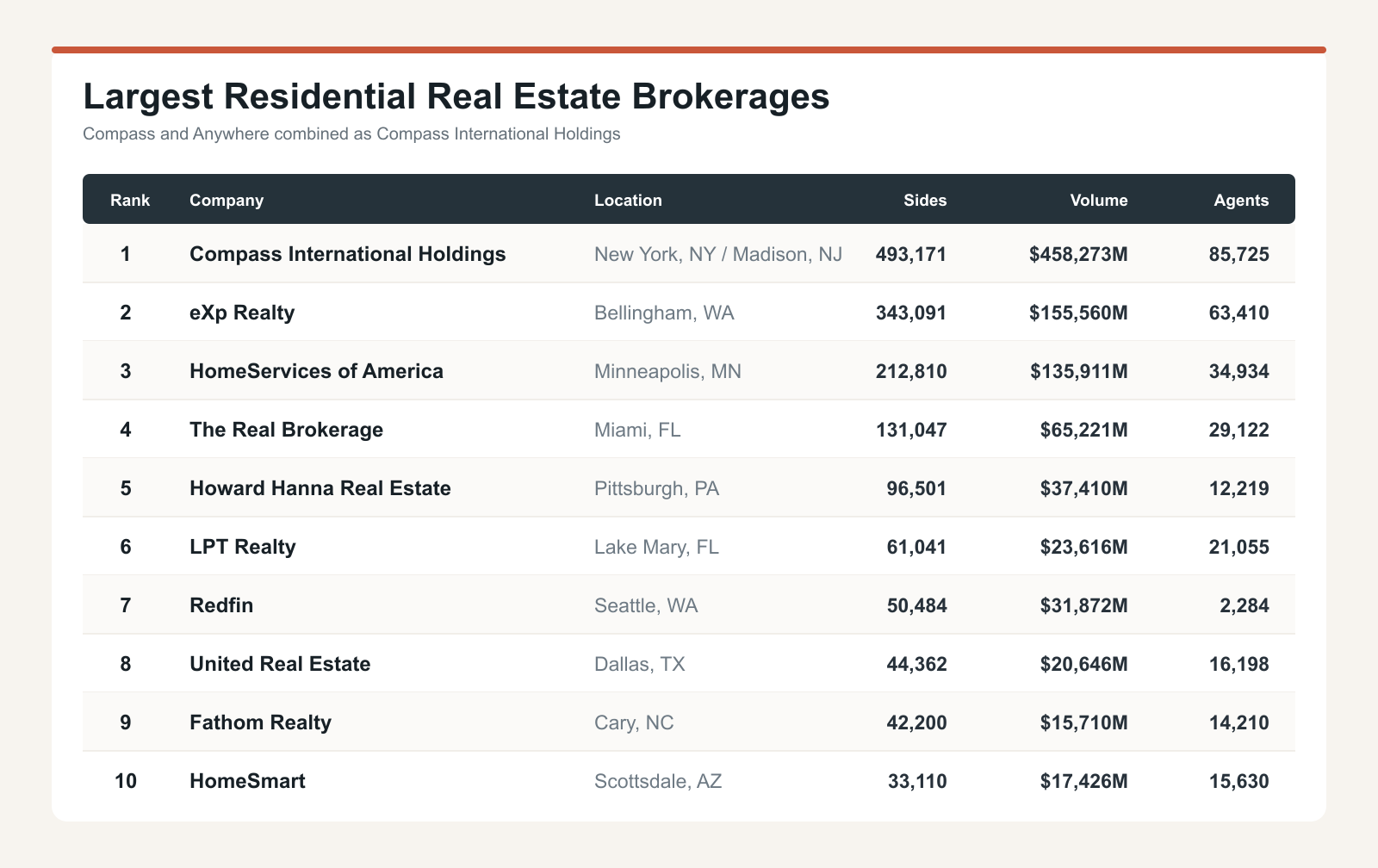
then I get why you would be totally against "weaponizing listings for recruiting."
Note that the above numbers are just for brokerage. Real just acquired RE/MAX. Compass has all of the franchise brands. HomeServices of America does not include the BHHS network numbers. KW is not represented above because it's a franchise network, but in reality, the network effects remain viable for them.
Which means that LPT is not close to its larger competitors in terms of network size, which could be important for recruiting and retention.
So yeah, LPT's growth stalls like GOP chances of victory in the midterms if its competitors are able to utilize network effects for recruiting. Now it makes sense why Palmer insists on "within MLS guidelines."
Thing is, none of that matters to consumers, to lofty rhetoric about fiduciary duty, to confident claims about history rewarding efforts or not. There is no reason whatsoever to care about whether an industry's shift helps or hurts the recruiting model of one company over another, or advantages the small independent or not. That's all just business, people making money providing services to other people.
It just so happens that we have a mechanism already in place for deciding what sorts of businesses ought to win over other kinds of businesses. It's called the free market.
We could give that a shot maybe?
Brief Conclusion
None of this is meant as any kind of an attack on either Vanessa or LPT Realty or Robert Palmer. They're good people doing what's best for them.
However, cut through the rhetoric and grandstanding, and what you get is hidden panic that their ability to compete as they used to is under threat. Because it is. The institution that was restricting the ability of bigger brokerages from competing on the basis of network size and listing count is... changing. Many are resisting the change, and quite a few brokers and agents are opposed to the MLS changing. And yet, it is changing. Zillow has stepped into the breach, for now, but with Zillow's own pivot to Zillow Preview, even that isn't going to prevent the change coming.
So we are treated to the spectacle of people interrupting their competitors when they are in the middle of making a mistake. Because it turns out, they're not making a mistake. They are leveraging a competitive advantage that they now have with the MLS backing off. That their competitors would rather they not be able to leverage that is immaterial, because the free market will do free market things.
Ultimately, this entire conflict gets resolved when the consumers speak up and tell us all what they want. Not with op/ed pieces or with social media posts, but with their wallets by hiring those brokers and agents giving them what they want.
If that's wide open access and transparency, then nothing Compass or anybody else says will matter. If that's private listings and Coming Soon, then nothing Zillow or anybody else says will matter.
Panic on the streets of Birmingham is unwarranted. Talking about the mistakes of your competitor is counterproductive. Arguments won't be settled with words. Just live your convictions, offer buyers and sellers what you believe they want, and win the argument with the only thing that matters in business: more clients, more business, more money.
-rsh