
A response to Rob Hahn’s “Do Less, MLS.”
Last week I wrote about the wave of pre-market listing deals reshaping the industry. Especially on a publication as new as this one, you never really know how a piece is going to land after you hit publish.
What I definitely did not expect was for Rob Hahn — one of the most respected voices in the real estate industry — to read it, share it, and then write a two-part response on NotoriousROB laying out a detailed vision for how the MLS should fundamentally restructure itself. (If you haven’t read Rob’s pieces, you should: Part 1 and Part 2.)
I’m honored that he engaged with my piece so deeply.
I also feel a bit like the guy who rolled up in a Camry to the local Corvette meetup.
Sure, I’ve put in some solid miles—I’d even call myself safely reliable—but it does none of us any good to pretend I’ve got the same horsepower as someone who’s been engaging with these issues for decades. Rob brings historical context, institutional knowledge, and relationships with MLS leadership that I simply don’t have.
So, what do I bring to the conversation? An active, boots-on-the-ground perspective.
I come at these issues as a guy who’s paying his mortgage this month by helping buyers and sellers get homes under contract. (And thank Claude for two new contracts this week.)
All to say, my plea for people to pay attention to the ‘pre-market arms race’ isn’t driven by policy theory. It’s driven by a practical need to protect an institution that I believe is vital to both my and my clients’ success.
Losing the MLS as it functions today threatens the whole value proposition of being and having an agent.
And that’s the lens I’m bringing to this response. Not a counter-proposal. Not a policy paper. But an everyday broker’s honest reaction to a big idea from someone I respect.
What Rob Got Me to Rethink
I always want to start here, because intellectual honesty matters more to me than “winning” an argument.
Rob’s central insight is that the MLS has drifted far beyond its original purpose. It was designed as a B2B cooperation platform: you earn a client, you use the MLS to serve that client. Somewhere along the way, through IDX and syndication, it became a B2C marketing and lead-generation platform. That transformation created the conditions for Zillow to build an empire on top of MLS data, which is what’s now driving some brokerages to pull their listings out.
Admittedly, I took that history for granted.
I came into the industry after IDX was already baked into the cake. I never stopped to ask whether the MLS should be doing listing distribution in the first place. It’s a great question that Rob raises, and it’s worth wrestling with. On this issue, I’m still undecided.
He also brought up a 2005 quote from Geoff Lewis, former EVP at RE/MAX, who essentially predicted exactly what’s happening now: opening the MLS for internet display by parties who don’t engage in brokerage would risk causing genuine brokers to withdraw.
Twenty years later, that’s more or less the story.
So I take Rob’s diagnosis seriously. The MLS expanded beyond its original scope, and that expansion created real vulnerabilities. Now that the chickens are coming home to roost, the industry is forced to ask: what do we do about it?
This is where Rob and I diverge.
But the more I’ve sat with Rob’s “MLS, Do Less” framework, the more I’m convinced the conversation — even beyond the scope of Rob and I — has been focused on the wrong thing.
Let’s Set Marketing Aside. The Real Issue Is Data.
Rob frames the problem as the MLS doing too much, specifically in the arena of marketing and lead generation. His solution: get the MLS out of marketing entirely. End IDX. Let brokers handle their own listing distribution. If the MLS stops trying to control how listings are marketed, brokerages lose their incentive to route around it.
Let’s grant that and, for hypothetical purposes, say we axe the IDX feeds tomorrow, putting marketing entirely in the hands of each broker.
The question becomes, does Compass and every other brokerage with a private listing network immediately enter all their listings into the exclusively B2B MLS cooperative?
I don’t believe they do. Which tells me that marketing rules and syndication are downstream of what’s actually under attack.
Let’s take Compass at their own words.
On their Three Phase Marketing Strategy page, Compass lists the key advantages of their approach. One of the selling points, right alongside testing aspirational pricing and harnessing the power of marketing, is this:

“Protect and control their data.” That’s not a complaint about MLS rules being too rigid. That’s an explicit acknowledgment that the strategy is about keeping information out of shared systems.
And it goes further. Compass frames the data that portals and the MLS make visible — days on market, price drops, automated valuations — not as market transparency, but as threats to homeowners:
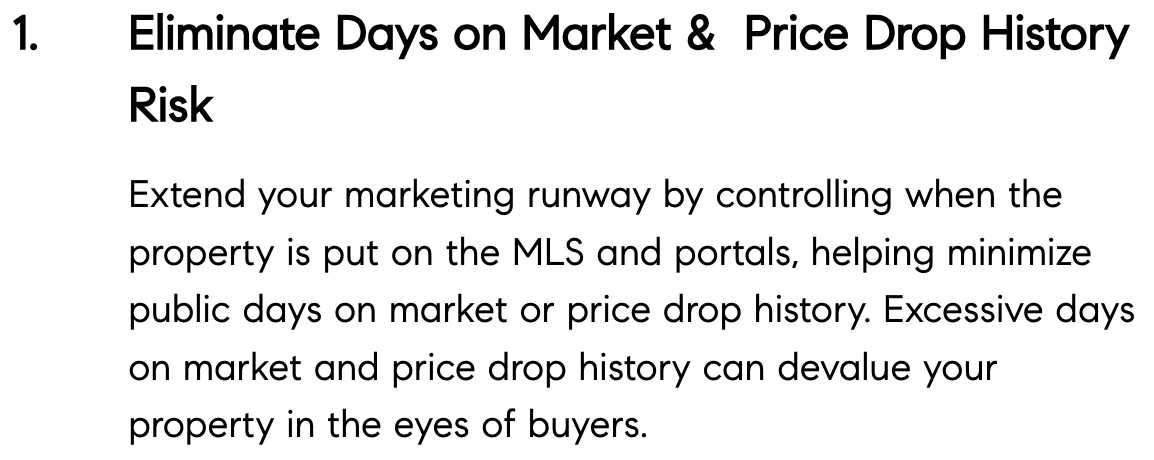
Think about what they’re saying here.
Days on market isn’t a “negative insight.” It’s a fact. Price drop history isn’t an attack on the seller. It’s market information.
Compass is telling sellers that market transparency itself is the enemy.
Where does this problem begin? As soon as a listing enters the MLS. Because once a home is in the MLS, any brokerage with an IDX feed — or Rob’s proposed API access — can surface that data however they want.
Once in the MLS, Compass’s promises to sellers to hide days on market, suppress price drops, test aspirational pricing, etc., etc., all go to shit. By definition, at that point the data is no longer exclusively theirs to guard and leverage. If another broker wants to publish a report showing the Compass property’s DOM and price history, there’s nothing Compass can do to stop them.
The Private Exclusive isn’t merely a marketing strategy. It’s a data strategy. And the MLS dropping its rules about marketing and chopping off the IDX feeds would not cause Compass to drop their Three Phase Marketing Strategy. Because it’s not about the marketing. It’s about controlling the information.
So, the issue at hand isn’t whether the MLS should regulate marketing. It’s whether we’re going to protect the MLS’s function as a single source of truth for the housing market.
The Single Source of Truth & What Happens When It Breaks
Here’s what the MLS provides that no private network, no portal, and no brokerage ecosystem can replicate: a comprehensive, neutral, shared data set. Every listing. Every status change. Every price reduction. Every pending. Every close. Every day on market.
Speaking as an agent, I depend on this data every single day.
When I create a CMA for a seller, I need to trust that the numbers reflect what’s actually happening. Average days on market. Closed sale prices. Pending timelines. Absorption rates. All of it depends on comprehensive, standardized data flowing through one system.
Here’s how fragmentation corrupts that.
A home sits as a Compass Private Exclusive for 60 days. For the entire period, the MLS is functionally blind to its existence. Then, after failing to sell on the private listing network, it enters the MLS and sells 21 days later. The MLS records show a 21-day sale. Multiply this across hundreds or thousands of transactions and your market data is distorted. Average DOM drops artificially. The market looks hotter than it is. Buyers feel more urgency than warranted. Agents price homes based on incomplete comps. Everyone is making decisions based on a picture with holes in it.
And when Compass claims that Private Exclusives sell for more and faster than MLS-listed homes?
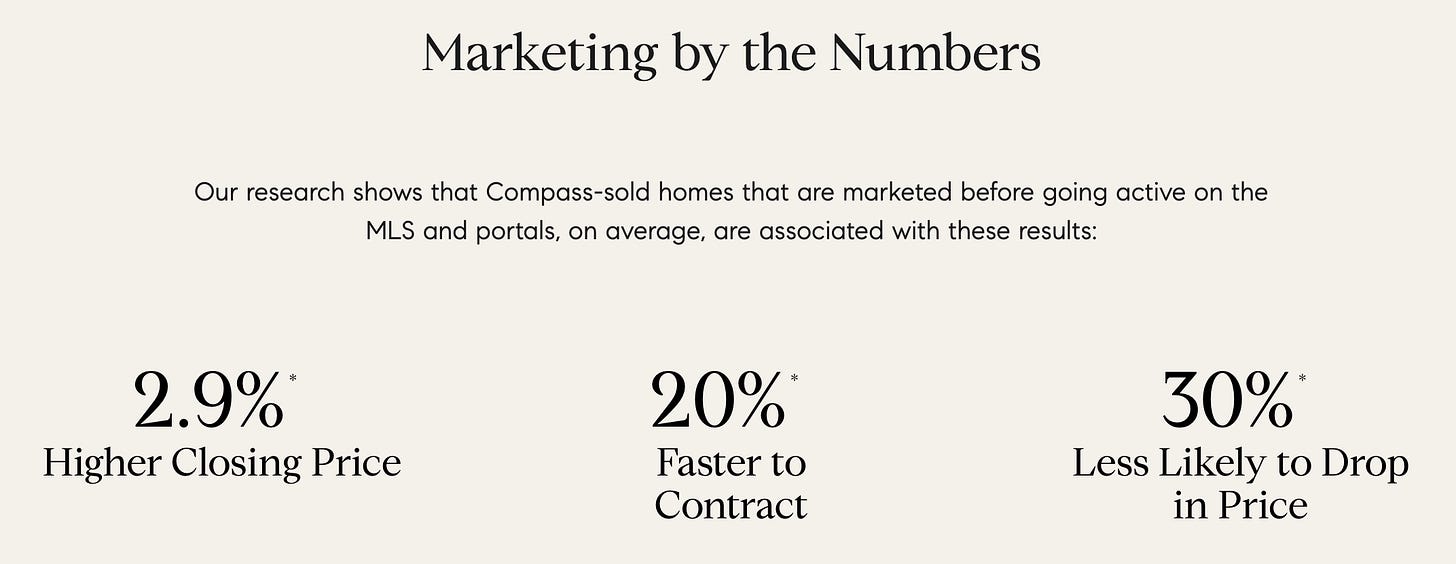
Impressive numbers. But look at the fine print:

“Source: Compass data.”
“Correlation does not necessarily equal causation.”
“Compass makes no warranty, representation or guarantee as to the accuracy of these results.”
It’s like McDonald’s claiming Big Macs are good for heart health according to studies performed by . . . McDonald’s.
Without the MLS as a neutral, comprehensive data set, there’s no independent way to verify these claims. And the MLS’s data function isn’t marketing. It isn’t lead generation. It’s the foundation of sound professional advice. If anything, that is the most B2B thing the MLS does.
But it breaks the moment a meaningful share of transactions take place outside the system.
That’s why marketing guardrails like Clear Cooperation exist — not to control how brokerages market, but to protect the completeness of the data.
Think of it like a condo building. You own your unit. You can renovate however you want inside your walls. But you can’t rip out a load-bearing wall, because one person’s renovation can compromise everyone else’s foundation. The MLS’s data set is the load-bearing wall. Entry timing requirements are simply the rules that keep people from ripping it out.
So yes, any entry timing requirement is going to constrain marketing. But we accept constraints on individual behavior all the time when they protect a shared resource. Entry timing requirements constrain marketing timing, yes. But they do it in service of maintaining a data set that everyone depends on. That’s different from the MLS dictating your photo requirements or your syndication strategy. The MLS shouldn’t control how you market. But setting a minimum standard for when data enters the shared system is a justified cost of participating in a cooperative.
I know the objection: ‘But the seller chose this.’ And I take seller autonomy seriously. But we don’t treat seller choice as absolute anywhere else in real estate. Sellers can’t hide known defects. Sellers can’t discriminate in who they show to. The entire regulatory structure of this industry exists because individual choices can have collective consequences.
The question was never whether sellers should have choice. It’s whether that choice should come with honest framing. When a seller is told that market transparency ‘devalues’ their home, they’re making a decision based on a pitch, not a balanced presentation of trade-offs. That’s not choice. That’s marketing.
What About Fiduciary Duty?
So the guardrails have a purpose. But Rob would argue they’re unnecessary. His model assumes that if you make the MLS less burdensome, brokerages will cooperate voluntarily because cooperation is in everyone’s interest and an agent’s fiduciary duty will cause them to act in the best interest of their client — in this case, the seller.
I wish I could, but I don’t share his optimism.
I’ve already made the argument that timing requirements for entry into the MLS torpedo at least the first phase of Compass’s private listing strategy. I don’t foresee Reffkin relenting on this out of a spirit of cooperation and generosity. Too much of Compass International Holdings’ profitability is staked on growing their Private Listing Network. I won’t rehash that argument any further here.
But what about fiduciary duty? Rob contends a listing broker who withholds a listing from the MLS to benefit the brokerage over the seller faces license revocation and profit rescission. That legal obligation is real.
The problem is, fiduciary duty is enforced after the fact, through complaints and investigations. And, again, Rob is a greater expert here than I, but my hunch is that proving breach of fiduciary responsibility is a real bitch.
Further complicating the matter, Compass is marketing restricted exposure as the fiduciary choice, telling sellers that the MLS and portals add “negative insights that devalue homes.” I think many (most?) Compass agents believe this is true. When they convey that belief such that the seller also buys-in and ‘chooses’ the strategy, who files the complaint?
I’m not saying there won’t be lawsuits. My bet is there will. But I’m acknowledging that the road to hell is paved with good intentions, and that well meaning, Kool-Aid drinking agents may unknowingly violate their fiduciary duties in the name of ‘seller choice.’
To that end, I’d rather build a system that works even when people act in their own self-interest or ignorance than one that depends on everyone always being on their best behavior.
What I Need the MLS to Be
Clearly, I’m not an MLS policy architect. I’m no IDX historian, much less an expert in VOW regulations, or API design.
But I know what I need the MLS to do and be.
For my buyers: completeness. I need every broker-listed property visible. Reliable, standardized data. No gaps in the picture. The ability to tell my client with confidence: if it’s for sale, we can find it.
For my sellers: maximum exposure from day one. A short Coming Soon window, maybe up to seven days, to build interest within the MLS. With exceedingly rare exceptions, if a home is for sale, it should be on the market. Everything beyond that is playing games with a system that only works if everyone is bought-in.
For my practice as an agent: comprehensive market data. Accurate CMAs. Complete days on market, pending, and closed sale information. The ability to advise clients based on the full picture, not a partial one cobbled together from public records and scattered portal feeds.
For everyone: a system where equal access is the default. Not perfect. But structurally designed so that the information available to you isn’t determined by which brokerage you work with or which portal you happened to open.
If the MLS can’t guarantee these things, I’m not sure what it is. And if “Do Less” means doing less of these things, then we’re not making the MLS leaner. We’re making it irrelevant. To have enduring value, it’s got to be all or nothing.
The Part That Should Keep Us All Up at Night
I want to close with something that goes beyond the structural debate.
When the MLS ensures centralized listing distribution, it creates a baseline of equal access. Every licensed broker sees every listing. Every buyer, regardless of which brokerage their agent works for, has the same inventory available. That’s not just a convenience. It’s a civil rights function.
When marketing is left entirely to individual brokerages, a listing broker’s private network becomes the first filter for who sees a home. Those networks tend to reflect the demographics of the communities the brokerage already serves. Nobody intends to discriminate. But the structural effect is that some buyers never get a fair shot at certain homes during the window when those homes are most likely to sell.
We’ve seen this dynamic in lending. Before the Home Mortgage Disclosure Act required centralized reporting, individual lenders could deny loans in patterns that amounted to redlining and nobody could see it. HMDA didn’t make discrimination illegal; it already was. But centralized reporting made discrimination visible. The structural default mattered more than individual intent.
I recently came across an Instagram video of two Compass agents walking up to the door of a privately listed home. One asks the other, “Wait, who has access?” The response: “Only the right ones.“
I genuinely don’t think they meant anything malicious. But, intentions aside, the whole presentation doesn’t sit right — at least with me. And it makes my point. When access to a listing depends on being connected to the right brokerage, “the right ones” becomes a structural filter, regardless of intent. That’s the kind of language that fair housing law exists to scrutinize. And the fact that it was said casually, on camera, as a selling point, tells you how normalized exclusionary access has become.
I suspect Rob and I agree on more than we disagree.
We both want the MLS to survive.
We both think it needs to evolve.
Where we part ways: Rob sees an MLS that overstepped into marketing and needs to retreat. I see an MLS whose most important function was never marketing in the first place. It’s data. It’s the single source of truth. And protecting that source of truth requires some guardrails around when and how listings enter the system. Not because the MLS should control marketing. But because the data’s value depends on completeness, and completeness doesn’t happen by accident.
The MLS doesn’t need to do everything. But it needs to protect the one thing that only a shared, cooperative system can provide: a complete, reliable, and fair picture of the housing market.
I really don’t think that’s too much to ask.
Wanna connect further?
Calling Balls & Strikes from a Player's Perspective: Realtor Gone Rogue
Tiered & Flat Fee Real Estate Services in SW Washington: The Tartan Team
DIY Homebuyer Resources & Advocacy: DIY Homebuyer Academy
Connect with me on socials (I’m most active on LinkedIn) @NickAufenkamp