

Nick Aufenkamp is turning out to be one of the best writers I have run across, who is thoughtful in making the case and in debating the substantive issues.
He recently wrote a response to my response to his original post, and I liked it quite a bit. I took the step of inviting him to publish it here, because not all of you read his stuff. Please go read that if you haven't yet.
 Nick Aufenkamp
That's how you do debates and disagreements about ideas. Not with name calling and virtue signaling and stupid games that win you stupid prizes, but with rational discussion.
I thought he made really excellent points, and wanted to continue the discussion. I actually think Nick and I are actually very close to agreeing. See what you think at the end of this post.
So with that, let's get into it. This is a public post because Nick's post was public.
Nick's Concerns on Private Listing Networks
Nick's motivations are fairly straightforward and likely shared by many brokers and agents out there:
All to say, my plea for people to pay attention to the ‘pre-market arms race’ isn’t driven by policy theory. It’s driven by a practical need to protect an institution that I believe is vital to both my and my clients’ success.
Losing the MLS as it functions today threatens the whole value proposition of being and having an agent.
I actually believe that restoring the MLS strengthens the value proposition of an agent, but let me tackle that below.
Nick believes that the private listing movement is not about marketing, but about control over the data. He poses a hypothetical where the MLS gets out of marketing and eliminates IDX. He then asks:
The question becomes, does Compass and every other brokerage with a private listing network immediately enter all their listings into the exclusively B2B MLS cooperative?
I don’t believe they do. Which tells me that marketing rules and syndication are downstream of what’s actually under attack.
Parsing What Compass Said
Nick points out Compass's own words about why they are so strongly for 3PM:
On their Three Phase Marketing Strategy page, Compass lists the key advantages of their approach. One of the selling points, right alongside testing aspirational pricing and harnessing the power of marketing, is this:

“Protect and control their data.” That’s not a complaint about MLS rules being too rigid. That’s an explicit acknowledgment that the strategy is about keeping information out of shared systems.
I would ask Nick and others to actually read what Compass says though. Don't stop at the headline of "Protect and Control Their Data." Read the sentence after: "They control which websites their photos, address, and data appear on and protect their data."
Nick also writes:
And it goes further. Compass frames the data that portals and the MLS make visible — days on market, price drops, automated valuations — not as market transparency, but as threats to homeowners:
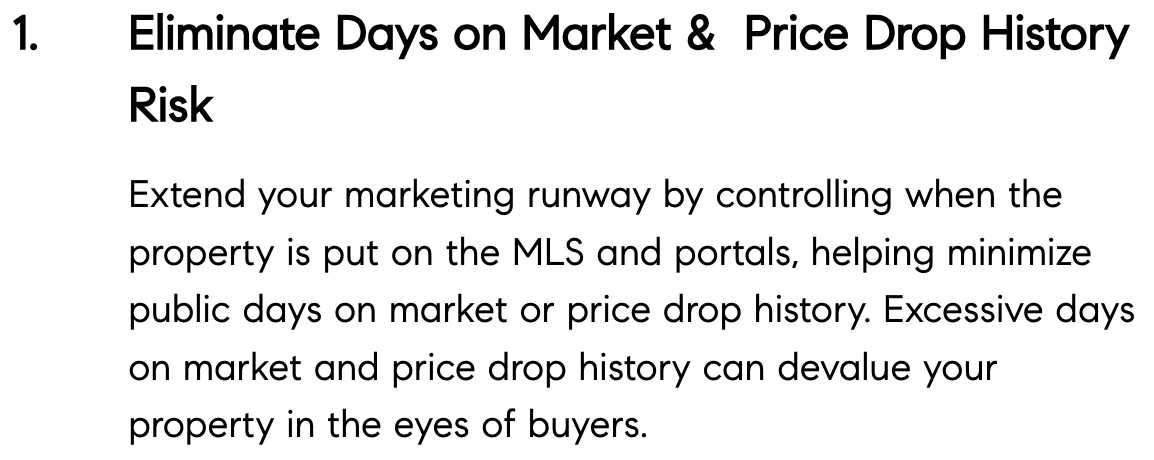
Think about what they’re saying here.
Days on market isn’t a “negative insight.” It’s a fact. Price drop history isn’t an attack on the seller. It’s market information.
Again, I think Nick reads the headline and then overlooks the most important word in the message of that bullet point: "public." Now, that's not his fault – that's Compass's fault for failing to communicate more clearly.
What I read is "...helping minimize public days on market or price drop history. Excessive days on market and price drop history can devalue your property in the eyes of buyers."
We all know that buyers cannot be members of the MLS. We know that the only way that buyers can see days on market or price drop history is if those are displayed somewhere where they can see them. That means public websites and portals.
I could be dead-wrong, and frankly, we could use Compass or Howard Hanna or Zillow or Redfin or any of those doing Coming Soon to chime in, but... my strong sense is that Compass is not concerned about Nick pulling up DOM and price history on one of its listings to share with his client. Compass, after all, wants to pull up DOM and price history on one of Nick's listings to share with their buyer clients as well. That's cooperation.
The Counter-Evidence
But we don't have to guess all that hard. Compass has been busy telling us for a while now.
A simple Google Search shows a fairly long list of Robert Reffkin saying that Compass will coooperate with everybody. This story from Real Estate News is an example:
Just a couple of weeks after Zillow called the push for private listings an attempt to "double-dip" on commissions, Compass has made a point of publicly inviting all agents to access its Coming Soon listings.
"At Compass, we co-broke with everyone," CEO and Founder Robert Reffkin said in a statement.
And he suggested that the company would go further if it could, but "NAR and local MLS mandates related to the Clear Cooperation Policy prevent Compass agents from sharing their Private Exclusives with non-Compass agents," Reffkin noted.
"We are working to ensure that NAR and the MLS no longer force homeowners to market their properties in ways that disadvantage them."
So if I read this correctly, the reason why Compass didn't share its private exclusives with other brokers and agents is because the MLS would punish them for doing so and then failing to make those listings available in IDX or public marketing.
Remember the printed book that Compass was doing in 2025? The entire industry laughed at them and made fun of it. "We going back to 1965?" was a common joke.
But this The Real Deal story shed some light on it that changes the printed book angle quite a bit:
But the brokerage described the book in a press release as “a move to promote greater transparency and collaboration.” The move appears to be a response to the groundswell of pushback the firm has faced for the use of its three-phase marketing strategy, of which two phases involve listings that do not publicly appear on the MLS.
“If Compass’ goal were to double end deals, it would keep office exclusives in-house as NAR’s Clear Cooperation Policy allows, but instead Compass is trying to share its Private Exclusives with the entire brokerage community,” the firm said in a statement.
So the printed book gambit turns out to be a way for Compass to try to get around the MLS's marketing-related rules (CCP) while trying to cooperate with other brokers and agents. Well, that changes the picture a bit, doesn't it?
And here's Inman News in 2025 reporting that Compass offered to share its exclusive listings with other brokerages:
Compass made a surprise move on Friday, saying it will share its exclusive inventory with any brokerage and multiple listing services (MLS).
However, the NYC-based brokerage that has fiercely championed private listing networks said its offer comes with two conditions: The brokerage or MLS agrees not to alter or monetize the homeowners’ listings in any way, keeping the listing agent front and center, and the brokerage or MLS can ensure agents won’t be fined or banned for sharing listings with the brokerage or MLS.
Those hardly seem like the moves of a company interested in controlling the data and keeping the data from other brokers and agents. They do seem like the moves of a company interested in controlling how the property is marketed to the public via public-facing websites and portals.
The MLS that Nick Wants
Whatever the fear and motivation, Nick wants to tweak and reform the MLS. He provides a really nice description of what he wants from the MLS as a working real estate agent on the ground:
For my buyers: completeness. I need every broker-listed property visible. Reliable, standardized data. No gaps in the picture. The ability to tell my client with confidence: if it's for sale, we can find it.
For my practice as an agent: comprehensive market data. Accurate CMAs. Complete days on market, pending, and closed sale information. The ability to advise clients based on the full picture, not a partial one cobbled together from public records and scattered portal feeds.
For everyone: a system where equal access is the default. Not perfect. But structurally designed so that the information available to you isn't determined by which brokerage you work with or which portal you happened to open.
I agree with every word of that. Every professional who is a member of the MLS should have access to the full listing data so they can serve their clients. Comps, DOM, price change history, off-market status, all of it. Equal access is the default. Anyone screwing with that should be removed. I don't think Reffkin, from what I can tell, would disagree with any of it either.
Where Nick and I part company is on one item from his list. So let's talk about it.
Responsibility and Authority for Marketing
The one place where Nick and I differ is when he writes:
For my sellers: maximum exposure from day one. A short Coming Soon window, maybe up to seven days, to build interest within the MLS. With exceedingly rare exceptions, if a home is for sale, it should be on the market. Everything beyond that is playing games with a system that only works if everyone is bought-in.
To me, this is the core of the disagreement and one that needs to be bridged if we are to move forward as an industry.
The issue here is about who has the responsibility and the authority to market a property. The answer should be obvious: the listing broker. The seller hired that broker, and no one else, to sell the house.
Nick writes that he wants "maximum exposure from day one" for his sellers. And if that's what he and his seller agree is the best strategy, he should get that.
But if I am the client, I am thinking: I hired you to sell my house; I did not hire the MLS to do it. I did not hire the thousands of other brokers and agents in the MLS to sell my house; I hired you.
So it is your responsibility to market my house. If you think the best strategy is maximum exposure, then do that. I don't care how you do it, but that's on you, not the MLS. Direct syndication to Zillow? Manual listing entry into Homes.com? As the client, I don't care what you have to do to carry out your responsibility; I just want you to get it done. If your strategy of maximum exposure includes skywriting with airplanes, then don't tell me you can't because your MLS doesn't offer skywriting. Figure it out, because you are my agent, not those other companies.
If you think the best strategy is limited exposure, then do that. If I'm going to put the responsibility on you as the professional expert I hired to help me, then I also need to give you the authority to do as you see fit. As long as you didn't lie to me or breach your duty to me in some other way, and I made a truly informed choice, we're good. I do not accept you offloading either the responsibility or the authority to some third party I did not hire, like the MLS.
Seems to me this is the entire nub of the issue: why should the MLS, a third party the client did not hire, have such control over the marketing strategies of the broker, who the client did hire?
Again, if we were back in 2000, then fine — the MLS was the only real option for syndication given the technology of the time. But we're in 2026. The technology is within easy reach of any agent, any broker. We can't ignore the reality of technology advancement and change in resolving this issue.
Participating in a Shared System
Now, in my opinion, the best point that Nick makes in his very thoughtful essay is this:
So yes, any entry timing requirement is going to constrain marketing. But we accept constraints on individual behavior all the time when they protect a shared resource. Entry timing requirements constrain marketing timing, yes. But they do it in service of maintaining a data set that everyone depends on. That’s different from the MLS dictating your photo requirements or your syndication strategy. The MLS shouldn’t control how you market. But setting a minimum standard for when data enters the shared system is a justified cost of participating in a cooperative.
I know for a fact that my friend and podcast co-host Greg Robertson feels this way. He thinks that Compass and others are taking advantage of the cooperative and destroying it, that there is a responsibility in joining a cooperative to protect the shared resource that is the MLS.
My answer to Greg and to Nick and to all of the well-meaning thoughtful people struggling with this issue is this: I completely agree on cost of participating in a cooperative, but the issue here is not about timing of entry, but the usage of the data.
I have argued that mandatory entry rules and timing rules for a Cooperation MLS are both justified and necessary. If you don't want to submit all listings, or want to submit them late, then don't join the cooperative. But that is because the usage of the data is strictly limited to cooperation.
Once you layer on marketing and lead-generation, however, the "shared resource" argument falls apart. If we both can use the MLS to do lead-generation, but you put in 995 listings and I put in 5, in what way are those 1,000 listings a "shared resource" that we both must protect?
Brokers have, do and will accept cost of participation in a cooperation platform. They will not accept the cost of participation in a lead-gen platform where they put in more than they get out. That's just human nature.
The Deal: Reaching Towards Agreement
Let me try to head towards a conclusion of some kind. I think Nick and I agree far more than it might appear. I believe that Nick can get exactly what he wants: a neutral, accurate MLS with nearly all of the transactions in it. What he can't get is that neutral MLS that also governs marketing of properties.
The deal is simple and if you can get behind it, then you can help solve the thorniest problem of recent memory plaguing the industry. Here it is:
- All listings must be in the MLS. They must be complete, prompt, and accurate.
- All members will have full equal access to all MLS listings, as long as they are using MLS data for client service.
- The MLS will not engage in marketing and will not allow its listings to be used for marketing and lead generation.
- Marketing and lead generation are exclusively the domains of the listing broker, period, because the seller hired that broker and no one else to sell his house.
That is the Cooperation MLS. Everyone would join it. Everyone would contribute to it. No one would want to build their own version of that.
Value of the Agent
I mentioned above that I believe "losing the MLS as it functions today" actually strengthens the value proposition of the agent.
Today, any buyer and voyeur anywhere can go on any portal and find not just marketing but full product information on any house for sale. I went over that in my last post, so I won't belabor the point.
Once we restore the MLS to what it was and is supposed to be, the buyer can have all of the marketing materials and advertising info that the listing broker wants to put out to the world. All of the photos, the 3D walkthroughs, the features of the house that will get a buyer interested, price info, etc. etc. Just think like a marketer trying to sell something. The consumer can see all of that.
If he gets past the voyeur stage, the "just looking" stage and gets serious? If he wants to really know what kind of water heater is in the house, whether the flooring is ceramic or porcelain tile, what the HOA requirements might be, he's looking for product information.
Every agent who is a member of the Cooperation MLS will have that info. Some brokers will make product info public because they believe that is the best way to sell their clients' homes; power to them. Many won't, just like car companies don't give you every single detail of their powertrain, but do give you a lot of sexy glossy photos.
Tell me how that does not enhance the value proposition of the true real estate professional? Others might look at pretty pictures; he reads up on and understands the detailed information about a property. Consumers can look at thousands of houses to their heart's content; when it's time to get serious, they know they probably should call a professional.
Reaching for Agreement
Let me wrap this up with Nick's concluding words because I agree with it completely.
The MLS doesn’t need to do everything. But it needs to protect the one thing that only a shared, cooperative system can provide: a complete, reliable, and fair picture of the housing market.
I really don’t think that’s too much to ask.
He's right. The MLS doesn't need to do everything. It only needs to protect the one thing that only a shared cooperative system can provide: a complete, reliable, and fair picture of the housing market.
It only need give up marketing and lead generation, and put those responsibilities where they belong: with the broker who was hired to sell the house.
I really don't think that's too much to ask.
-rsh