

I wanted to write this. I can't quite figure out why. After all, I am no economist (though I look like one) and my track record for predicting the future is... well, as my friend Keith Robinson would say, "directionally correct but way off in timing."
Yet, these thoughts have been knocking around my head for months now and if for no other reason than for me to understand the full picture for myself, I thought I would write them down and share them with you. I often learn what I think by reading what I wrote.
The theme is how the residential real estate industry will fare given macroeconomic forces and trends. I have touched on and spoken about some of the macro factors in the past, but never really pulled all of it together to think about how they will impact the industry itself. I will include references and links to some of the people I find most persuasive about macroeconomics, and I do urge you all to check them out if you're interested.
Caveat: this is quite likely to get doom-y. I am going to make an effort to be as optimistic and as balanced as I can be, but you might want to read this towards the evening after your day is done. With a glass of something stronger than coffee.
Without further ado, let's think through things together, shall we?
Macroeconomic Factor: Geopolitics
The place to start is probably the most obvious place: big things popping. As I write this, we are into the seventh month of a war-that-is-not-a-war which many thought would be over in a week or two.
That war shut down the Strait of Hormuz. We all know this. Then it metastasized into Yemen and the Bab al-Mandeb Strait, threatening the Red Sea as well. It shows zero sign of being over anytime soon. Of course, the war in Ukraine did not end the day after Trump was sworn in either, so that impacts Russian oil and gas.
That oil prices haven't hit $200 a barrel puzzled many experts, but I recently heard an explanation that makes sense. Oil prices are from commodities exchanges, and amount to bets between huge financial institutions to be cash-settled. That is different from settlement by physical delivery. One oil and gas expert pointed that out in a podcast interview, and it stuck with me.
Because the physical stuff is skyrocketing in price. Diesel is above $6.50 here in Las Vegas area. There is talk of banning diesel exports. And we all know by now that diesel is a key input into everything, so the price of everything is going to spike up as well.
The industry has known that housing hit an affordability crisis a couple of years ago. Transactions went from 5 million in 2022 and 4 million in 2023 and haven't recovered since, but prices keep steading rising nonetheless.
Everyone talks about the "housing market" and looks at the price and thinks its healthy. We in the industry sometimes look at transaction count and know it is in a major recession and has been for a while now.
The preferred solution, advocated by NAR and REALTOR.com and some other large real estate institutions, is to build more housing. They say that we are short tens of millions of houses given the growth in our population, and that builders haven't kept up, and that the government ought to do all it can to remove barriers, permits, zoning regulations, environmental regulations, and so on so that more homes can be built.
Great. Except that the geopolitics factor means that everything that goes into building a house has become and will continue to be more expensive. Last I checked, most construction equipment uses diesel for power, and trucks deliver materials to job sites. NAHB reported in July that costs for building materials rose by 6.7% year over year, and that was before the current crisis in energy.
It is unclear to me how building more houses given current and likely future macro conditions leads to more affordable houses which are necessary for transaction counts to go up.
Macro Factor: Debt
The other way to get transactions up, of course, is to lower mortgage rates back down to the 2-3% range we saw before and during COVID. That would do two things:
- Give buyers more purchasing power; and
- Unlock sellers who are locked into their 3% mortgages.
So of course NAR and the industry are lobbying for lower rates.
Thing is, one of the things I learned a while back that has really come back to relevance today is that neither the Fed nor the government controls mortgage rates. We sometimes become (myself included) Fed Watchers and when Warsh raised rates recently by 25bps, there was gnashing of teeth in the industry.
But the Fed does not set mortgage rates. Mortgage rates are set by the bond market, by reference to the all-important 10-yr Treasury Bond. You can watch this explanation by a former mortgage banker turned political pundit if you'd like.
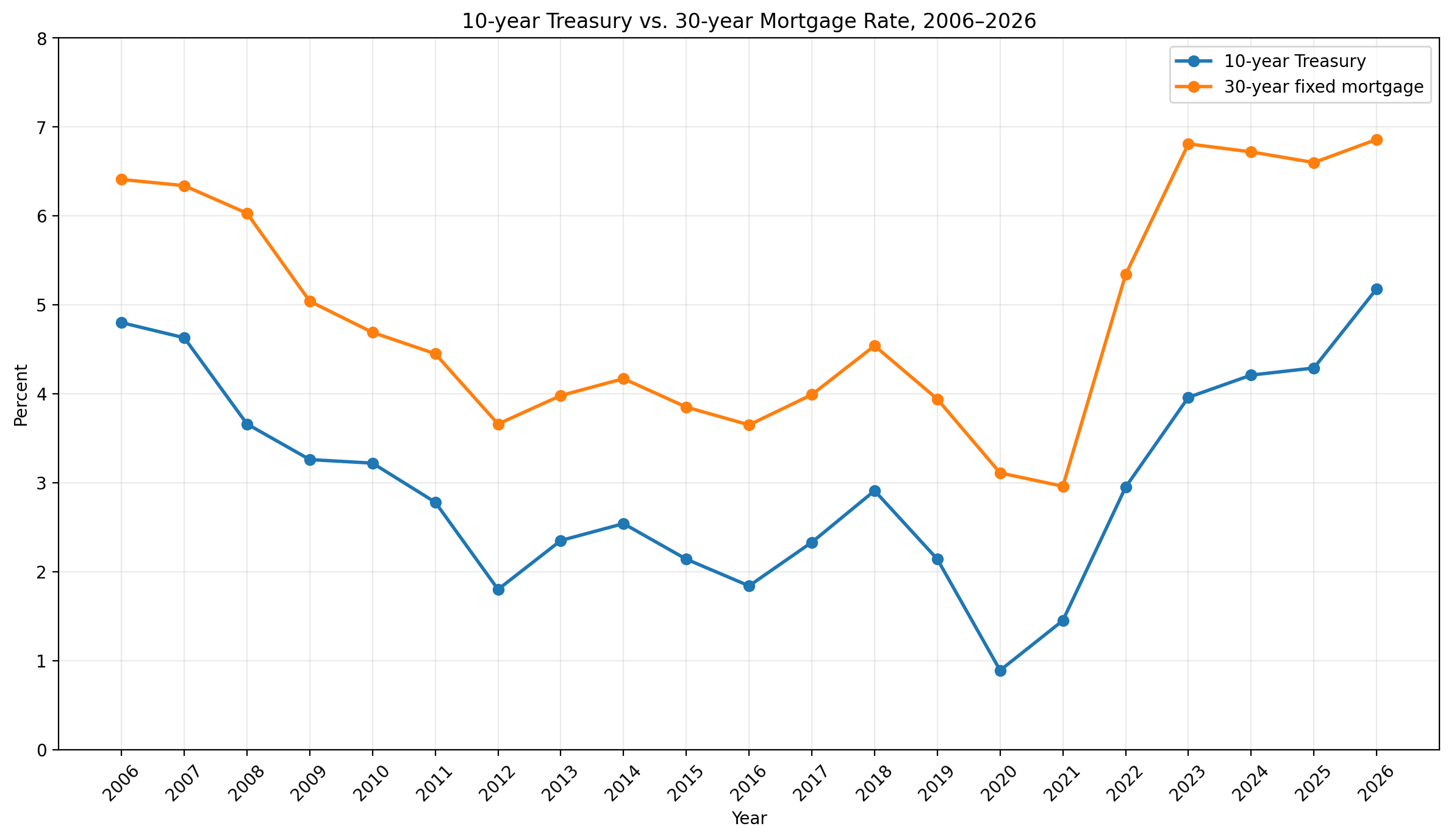
Well, a number of analysts I respect very much have pretty much said that the Fed and the government have lost control of the bond market. Look up Luke Gromen, Lyn Alden, Ray Dalio, Stanley Druckenmiller, Russell Napier, and others for their thoughts.
There are numerous reasons why, including Japan going through its crisis, Gulf monarchies suddenly going broke and needing to rebuild (at some point), etc. etc. but the fundamental underlying issue is simpler still: United States is $40 trillion in debt, and interest payments are now larger than defense spending. It is second only to Social Security in government spending. The U.S. needs to borrow roughly $2 trillion in new money this year and next year because that's the budget deficit we run. What's more, the Federal government also has to rollover maturing debt since, well, they can't pay that back.
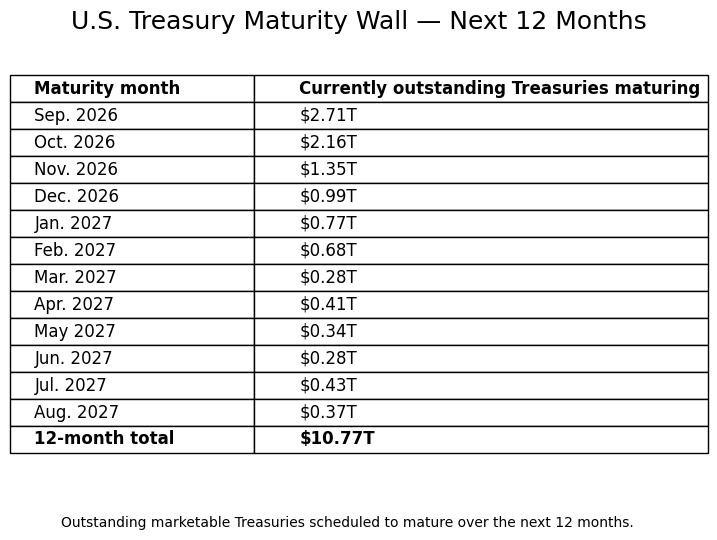
That's a lot of trillions of dollars that someone has to loan to the United States. I have often wondered what would convince a smart Wall Street bond fund manager to do this when it seems obvious to my dumb self that Uncle Sam ain't never paying that back... at least in real terms.
Which implies that bond investors are going to demand more interest, not less, to buy 10-year bonds for the foreseeable future. Which then implies that mortgage rates are not going down from here, and might rise substantially.
How the government could get mortgage rates back to 3% is... well... a mystery wrapped in a question. It can't, without completely changing the entire financial system somehow.
Macro Factor: AI
The third way to make housing affordable is to somehow double the real inflation-adjusted income of Americans. $6 gas isn't as big a deal if you get a 100% raise tomorrow.
I am an unabashed fan of AI for a lot of reasons. I have a company offering AI tools to brokerages after all. But I am far from alone in concluding that if AI is as valuable as OpenAI, Anthropic, and a bunch of investors say it is, then the reason for its value is that it will dramatically lower labor costs. That's what productivity means after all: people doing more in the same amount of time.
Maybe it isn't simply through mass layoffs though many Americans are worried about just that. But as of this writing, AI productivity seems constrained to the service industry: coding, law, accounting, marketing, etc. So productivity in those areas do not produce more chickens, more bread, more energy, more lumber, more stuff.
Which means that we are unlikely to see this doubling of American incomes anytime soon.
Shrinking Pie
Given these macro factors then, let's think about the industry.
I hope to be wrong about this, but I can't see how the overall market does anything but shrink. Fewer and fewer buyers, not because they don't want to own a home but because they simply can't afford it, is likely met with fewer and fewer sellers. After all, if you have a 3% fixed rate mortgage for the next 30 years, that's the actual asset, not the pile of bricks and wood you have to maintain and upkeep. I wrote that in this post back in 2021; five years later, that thesis appears to have borne out.
Maybe nominal prices keep rising, but that isn't a function of supply and demand but a function of dollar devaluation. I have posted this time and again, but it's worth reposting here:
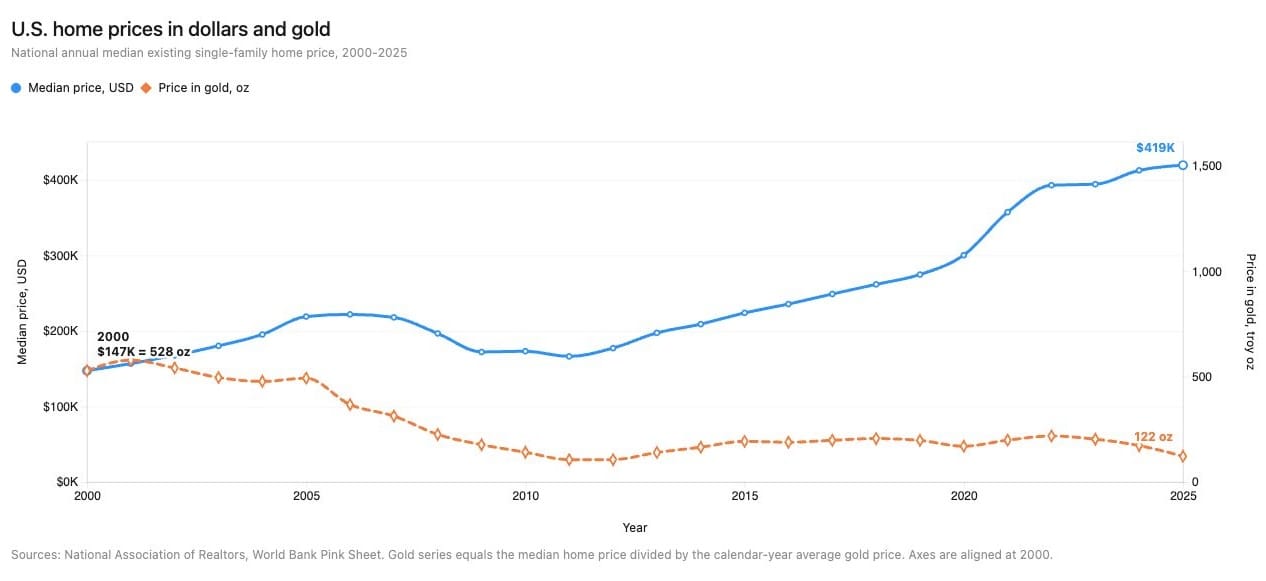
Practically speaking for the industry, this implies two things:
- Fewer transactions
- Higher prices (in dollars)
Those brokers and agents who manage to close deals should see larger and larger commission checks (nominally). But fewer and fewer agents will close deals simply because the number of deals will continue to fall.
New construction could pick up some of the slack as homebuilders might be able to move a lot of levers to "lower the price" without actually lowering the list price, but now we have to be really concerned about building costs and some kind of absolute limit there.
There is a theoretical scenario where homeowners start going into default en masse (AI-related layoffs maybe?) so we could see a return of REOs and foreclosures and short sales and the like. That could add a ton of inventory, lower prices all around, and get the housing market moving again. I am personally deeply skeptical that politicians will allow that to happen; they're not going to bail out homeowners after bailing out the banks the last time around? If they like being re-elected, they'll figure out something.
Competition was already hyper-fierce with over a million REALTORS chasing 4 million sales, but it can only get fiercer with a shrinking pie.
A K-Shaped Buyer's Market
My co-host Greg Robertson has been saying for a couple of years that he can't wait for a full-blown buyer's market to return to put an end to the whole private listings debate. I think he's about to get half of his wish.
We will be entering a buyer's market, if we're not already in it. But it will only be in the upper end of the K-shaped economy we are living in. The luxury segment will not be affected much, and the top 20% or so of Americans who own 71% of total household wealth are likely to find bargains when they go shopping. They can and will demand concessions from sellers since anyone selling in that market is "highly motivated" by definition.
What Greg is perhaps not thinking about, however, is the likely psychology of these wealthy buyers. Private listing networks and Coming Soon were born in the depths of the Bubble bursting when buyers had all the power. They wanted to see "special and unique" properties that were not subject to the same level of competition. They were the ones asking their agents, "You got anything special? Anything different? Anything that every Tom, Dick and Harry haven't seen yet?"
Today, the whole narrative is "seller choice." So those people who serve buyers tend to resist. What happens when the narrative is "buyer choice"?
If anything, I think private listing networks proliferate in the coming K-shaped buyer market.
Moving from High to Low
Agents who turned their noses up at serving the lower market segments, or working with buyers, during the good times will find themselves back in it because the times are bad. The top-tier experts with decades of experience and long track records of success will not be able to pass up the marginal buyer who may or may not get the mortgage approved because they can't really afford to be picky about what transactions they might be able to close.
The newer agents, the lower producing agents, the part-timers – they are going to face competition from those elite agents like many of them have never seen before. At 5 million transactions, top agents will let the crumbs fall off the table. At 4 million, fewer of them can pass those off. At 3 million transactions, I doubt any of them can. Especially if the commission check keeps getting larger and larger because nominal price of homes in dollars keep rising.
I saw this personally throughout the Bubble years, so I expect to see it again as the pie shrinks.
Concentration and Consolidation
Combine those two together and what you get is a strong incentive for consolidation and for concentration of market share. I might go so far as to call it inevitable. We have already seen a lot of it in the industry, with Compass buying Anywhere, Real buying RE/MAX and the like, but I think that trend accelerates.
If the K-shaped buyer's market means that demand for PLN comes not from sellers but from buyers, and increasingly the top elite producers are going after buyers, going after marginal deals, etc. then size really matters in a way it hasn't before.
I expect to see brokerage break out every weapon in its arsenal to recruit those producing agents, because there will be fewer and fewer of them, and reach for tools it hasn't considered before. I expect to see agent teams merging with one another because size and concentration of market power matters more than ever.
A lot of the chatterati in the industry will blame corporatism or whatever. But I think it will be market forces driving things more than anything else.
The MLS
The trend towards brokerage domination over the MLS will, therefore, accelerate. I have been writing and talking about MLS trends and strategies for too long for you all not to know, but let me summarize:
- Brokerage and team consolidation means MLS loses power.
- MLS value declines as technology advances and becomes more widespread.
- Shrinking pie means likely loss of subscribers as those in the middle get pushed out by top agents and teams moving in.
- NAR is out of the picture, and Zillow just suffered a major legal defeat.
Combine all of those (and more) and the trend is clearly towards greater consolidation and concentration of power among the MLSs as well. You could get super extreme with scenarios, but even a conservative outlook means fewer larger MLSs using AI to lower the cost of serving larger and larger subscriber counts. Maybe it isn't the Three Big MLS that I have theorized over the years, but it isn't 500 small fiefdoms either.
NAR and the REALTOR Associations
Some things are clear, while other things are very, very obscure.
What is clear is that shrinking markets means losing members, and even more so when the MLS finally divorces the Association. (Brokerage dominance naturally leads to such an outcome.) The Association then has to come up with some kind of an independent value proposition that will get people to join and pay them voluntarily, as opposed to being coerced into it.
The Association will fall back on the familiar trope: advocacy matters! Literally everyone, including me, says that the one real value proposition of the REALTOR Association is in political lobbying. That remains true.
What is obscure is whether that advocacy and lobbying remain effective.
First, the macro trends I led off with is somewhat beyond politics. It isn't clear how lobbying would change the geopolitical factors. Strait of Hormuz isn't getting opened by NAR lobbying. $40 trillion in debt and a breaking bond market is not fixable by normal politics. AI doing AI things is beyond normal advocacy work.
REALTORS have supported NAR and the Associations all these many decades because they were undoubtedly effective. REALTORS are an incredibly powerful political force. The question is, what happens if that powerful political force proves ineffective because what is impacting the industry now is beyond politics?
Second, NAR at least tends to really favor Boomers in its advocacy work. For example, consider this recent headline:

I mean, I fully understand why NAR touted this and why they supported the lawsuits. From the article:
One case was backed by NAR's Legal Action Program, which provides direct financial assistance and/or files amicus briefs to support litigation of significance to the real estate industry, the operation of real estate associations and private property rights. NAR maintains private property rights include “the right to rent out property on a short-term basis.”
“Legislative advocacy helps protect our industry through the lawmaking process, while the Legal Action Program helps protect it through the courts,” says Robin Dickson, who chairs the NAR committee behind the program. “Together, these efforts give REALTORS® an important voice in defending private property rights and the future of our profession.”
But consider for a moment how this news might sound to the 80% of Americans on the bottom half of the K-shaped economy. Consider how this looks to Millennial and Gen-Z voters who already think the Boomers are screwing them over.
Combine that with the long history of NAR strongly advocating for real estate investors and landlords (just Google it as there are numerous examples) at a moment in our nation's history where anger at the death of the American Dream is at an all-time high.
Sure, we all can agree that NAR is standing on principle and "defending private property rights." But it hardly strikes me as good politics, at least right now.
If political advocacy fails to deliver results, then there is a real question as to whether the Association remains relevant for anything beyond networking for diehards. Like I said, very very obscure and hard to see.
Portals and Vendors
Let me address the last major group in the industry.
Shrinking pie, K-shaped buyer market, proliferation of PLNs, advent of AI, and growing concentration/consolidation all point to certain more likely-than-not outcomes.
The portals will need to embrace PLNs somehow. Redfin has already done that, and Zillow has kinda done it with Zillow Preview. But again, the future PLN proliferation will be driven by buyer demand, not seller or broker demand. And that buyer's market has no clear ending date since it is being driven by macro factors beyond anybody's control.
At the same time, the web itself is losing value and power because of the rise of agentic AI. I know I am not the only person who no longer starts with Google, and many many others are trying to get ahead of the curve. I met someone at Blueprint who was working on "AEO" instead of "SEO" for example.
I don't think it means that the portals and vendors go away. They are far too important to the industry. However, I do think it means the nature of portals and nature of vendors change over the next few years as macro factors filter down through the industry.
Concentration of power and consolidation on all levels will drive a lot of that change. I don't see a long future, for example, for companies selling individual agent IDX websites. Large brokers, big agent teams, and top producing agents have rather different needs than Sally who just got her license last week and is filled with hope.
The White Pill
I realize this entire essay was essentially an exercise in black pill doomporn. That is not my intent; I just want to understand my own views more clearly and try to get as close to what I think reality will be. And ultimately, I am extremely hopeful and bullish for the industry.
The macro factors are serious and severe and beyond anybody's control right now. But they are also completely unsustainable. That which cannot go on, won't.
Geopolitics is chaotic. But assuming we don't have a global thermonuclear war, wars will end, peace treaties will be signed, and the world will get back to sanity at some point. Yes, systems might be destroyed, entire nations might cease to exist, empires will fall, and there will be death and misery in the meantime... but at some point, things will stabilize and improve.
$40 trillion in debt, and growing by $2 trillion per year, is unsustainable. So it will stop and eventually reverse course. Yes, it will be extraordinarily painful during that, but we will come out the other end one way or another.
AI might cause massive unemployment and disruption at first, but like all technologies ever created by man, it will eventually lead to more jobs, more opportunity, more productivity, and more wealth for everyone. Yes, it will suck in the meantime, but there is in fact a brighter future on the other side.
And through all of that, no matter what chaos and disruption we have to endure, people are going to want to live under a roof. And all of them will prefer that it be a roof that they own, instead of renting from a landlord. Maybe they can't afford to buy that home, but the desire to do so will persist. The human need for a home is part of human nature, whether that home is a cave surrounded by dire wolves or a penthouse condo in Metropole.
When it is all said and done, there will be a real estate industry, there will be men and women working in it, and people will continue to buy and sell houses for as long as there are people. We don't work in an optional industry. We don't deal in Pokemon cards, or luxury cars. We work in housing.
The challenge is... navigating what is coming through to the other end. Good luck and godspeed to us all.
-rsh