
I am currently working my way through a book I should have read years ago. It's called A Nation of REALTORS by Jeffrey Hornstein and was published in 2005. Hornstein has a Ph.D. in history but is not a professional academic; his LinkedIn shows him as the Executive Director of the Economy League of Greater Philadelphia, and worked in the labor movement.
So far, I am in the early chapters where Hornstein details the birth and early growth of the REALTOR movement through local boards, local exchanges, and the creation of NAR itself. It makes for absolutely fascinating reading for anyone who enjoys history.
There is one aspect of the story that I find particularly interesting, as it could have some importance for the present and the future. I know I'm thinking about it pretty hard, so I thought I'd share with you all to see what the best informed readers in the industry thought about it as well.
This will be a public post as I want as much feedback as possible.
For the TL;DR crowd: Associations began as relatively small organizations, even as they grew. They were a mixture of business oligopolies, civic organizations and critically, social clubs. That relatively small size was essential for the community and culture that the Association created. We might consider, then, what the optimal size of the modern Association should be.
The Birth of the Association
I think we in the industry all kind of knew this, but A Nation of REALTORS is the first place I read that documented with real serious research some of the real history.
While the full story is fascinating, especially from Hornstein's perspective as he theorizes on the formation of the American middle class, the high level story is very much what we have always heard. A group of honest and ethical real estate men got together to elevate the business, to fight rampant fraud and dishonesty, and to do business with other trustworthy real estate men.
It makes sense when one considers the very public image of the real estate broker in the 19th and early 20th centuries. Newspapers and periodicals of the time consistently painted real estate brokers as borderline or outright criminals who made fortunes by defrauding widows and young couples. In today's terms, real estate broker might be likened to OnlyFans creators: legal, but disreputable as hell.
Three things stand out, however, from the historical account.
First, these men were all among the "high class" brokers of their respective cities. They were routinely the highest producers in their cities. And it was always cities as there were not enough critical mass of real estate brokers out in the countryside.
Second, the Associations really took root in the Midwest and West as the nation expanded westward. These Associations sprang up first in the new metropolises of Chicago or Detroit or Denver and San Francisco rather than the older cities of Boston, New York and Philadelphia.
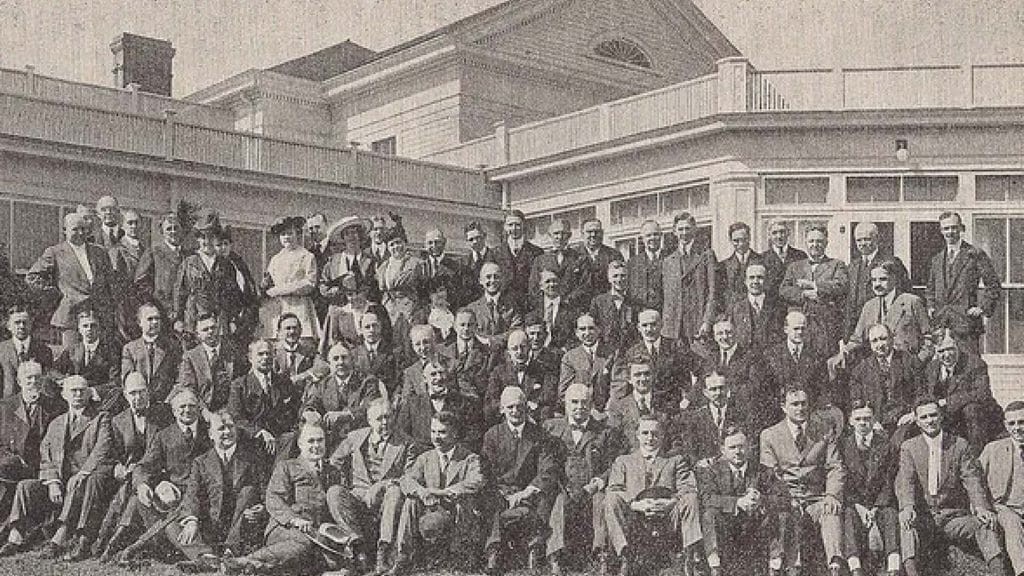
Third, they were all small by our standards and fairly exclusive. The book mentions one of the, if not the, largest real estate boards of the early 1900s: Chicago. It was one of the largest with "several hundred broker-members" who comprised of only 10% of the real estate agents in the city.
"Brotherhood"
In many ways, these early Associations were similar to other civic organizations like Rotary, Kiwanis, and Lions. Those organizations grew out of the fraternal lodges of the 19th century (Tocqueville noticing in the 1830s that Americans formed associations for everything) and from 1905 to 1920s became "service clubs" that they remain today.
Mixing business with civic-mindedness was common to all of these groups. The Rotary began as a business referral network after all, with one member per trade or profession. Cynics might say that the civic ideals and public service were an excuse for joining a business referral network... but we might just as easily say that businessmen who had achieved a level of success wanted to give back to the community. The early 1900s were, after all, the Progressive Era.
In any event, one theme that comes across very clearly about the early history of the Association was how important the social aspect was. These men got together not just to do business, but because they really enjoyed each other's company. A Nation of REALTORS says many local real estate boards started building their own headquarters from about 1910, which included amenities like "a barber shop, a smoking room, and a Turkish bath." The Philadelphia Board built its headquarters to be a "home" for members exuding "the warmth of fellowship," and it was considered key to bringing real estate brokers into "closer friendly relationship."
A direct impact of this social bonding was that for many of the early real estate men, the Association and membership in the Association, became an important part of their identity. It happens with every social organization; if it becomes important enough, it becomes part of who you are. Consider church-going Christians, the devoted Democrat/Republican, the avid golfer who belongs to XYZ Country Club, the active volunteer at the local food bank, etc. etc. They go for the stated activity/purpose (worshipping God, for example), but they also go because that's where many of their friends are.
Of course, these early boards were not exactly a lost paradise. Women were, of course, excluded even though there were female real estate brokers back then. Blacks were excluded from membership, all the way through the Civil Rights era. (NAR allowed membership in 1961, but local boards were far slower to adjust... and exclusion lasted in some places into the 70s. The Thompson lawsuit was brought in 1988 by black real estate brokers against Atlanta's MLS, and decided in 1991.)
Yet, there is something to learn from early history.
REALTOR Junkies
I have spent years working with and consulting for REALTOR Associations. Usually the single biggest challenge, the biggest issue, that an Association faces year after year after year is "member engagement." More precisely, it is "member dis-engagement." Associations spend enormous amounts of time, money and effort trying to communicate to members, inviting them to events, asking them to vote, asking them to volunteer, asking them to get involved.
Yet, very few people do. I once asked what quorum was for someone to be elected to an Association's Board of Directors was: the answer, "None." That means someone could get elected to govern an Association of thousands of members, with millions in annual budget, by voting for himself. In reality, it is hundreds of votes out of a membership of thousands that determines who leads an Association.
I was in the room when my friend Keith Robinson said that people shouldn't bitch about NAR if they're not involved. This is, of course, a very common refrain from those members and those leaders who sit on boards of directors and on committees when some criticism is leveled at the Association.
The rest of the industry even has a name for those active members: REALTOR Junkies. We talk out loud about REALTOR Prom, usually the big annual event where the new incoming President is crowned and the outgoing President applauded. The REALTOR Junkie is the person who volunteers, who sits on committees, who organizes events, and who ultimately runs for office and climbs the ladder to the Big Prize: President of NAR.
Which is one reason why for over ten years, I've been talking about RINOS: REALTORS In Name Only. I estimate that roughly 75-85% of any given Association's membership are not active in the Association in any way. They join to get access to the MLS, or because their broker requires it (Principal REALTOR rule), or because they need access to forms or lockboxes.
I have seen this personally over the years in a very specific way. I have been invited by Associations over the years to give presentations and speeches on various topics of interest to real estate brokers and agents. Everything from legal developments to technology to industry changes to macroeconomics. They are usually well-received by the audience. And that audience is never over a couple hundred people. The Association itself could have 10,000 members or 1,000 members. The audience is almost always fewer than 200.
I used to think that maybe this was the result of some kind of Mean Girls club keeping other people out. Maybe there is some of that, but reading about early history of the Association makes me reconsider.
The Dunbar Number: Smaller is Better
The British sociologist Robin Dunbar proposed the Dunbar Number in the 1990s. This is the number of people with whom a human being can maintain stable social relationships. He proposed 150; others have said the number is between 100 and 250.
That is approximately the number of "REALTOR Junkie" active members in any Association I have ever known, whether local, state or even NAR. The NAR Board of Directors may be more than 900 people, but it is really an aggregation of groups of 50-100 people who know each other sitting in the same auditorium.
And I find it remarkable that the early real estate boards were also about 100-200 people, growing to "several hundreds" of members... which implies social sub-groups who come together periodically.
If you belong to a huge REALTOR Association, such as Houston (45,000) or Miami/Beaches (93,000), there is no way that you would simply trust and socialize with someone because she is also a member of Houston or Miami/Beaches Association of REALTORS. One informal measure of the Dunbar Number from Robin Dunbar was that if you saw someone at a bar or restaurant, you would feel comfortable sitting next to them uninvited. There is no chance that two random REALTORS from Houston would do so just because they are both members of HAR.
But if two people who are REALTOR Junkies of HAR, who perhaps served on committees together, or saw each other often at HAR luncheon events, ran across each other at a bar... they would. They have a stable social relationship.
After learning about how effective a couple hundred real estate men were in organizing the industry, in influencing government (especially local municipal government), in shaping their local communities (quite literally in some cases, as REALTORS were heavily involved in things like zoning and building codes), and in raising the standard of professionalism... I wonder if the modern Association should not actively emulate their forefathers.
The Future Association: Smaller, Social, and Effective?
What would it take for the REALTOR Association to be a truly important part of a broker or agent's personal social identity?
True faith would be a start. If someone really felt that some real estate issue, whether fair housing or affordability or keeping the local community beautiful, was important and that the Association worked on those issues, then she might start to get involved.
But as the examples of the early Association show, that person becomes a member when she starts to form those stable social bonds with other members. When she starts to come to luncheons, to events, to golf outings, to parties, to "purely social" events of the Association because that's where she'll see many of her friends. That such relationships naturally lead to business and referrals is a given, of course, but... we all know the difference between doing business with a friend and someone trying to network with us for business purposes.
For anything like this to occur, the Association must divorce from the MLS almost completely. The MLS is for business purposes only, and has become an essential utility for anyone in real estate to be in real estate. Courts bring down the hammer whenever membership rules and qualifications interfere with that.
So let's assume that's done: the Association has nothing to do with the MLS, with forms, with lockboxes, or with anything necessary for business. It has become a purely social and civic organization. What does that look like?
I think it looks like the roughly 100-250 REALTOR Junkies who are actively involved in the 45,000 "member" Associations today. They know each other, they like each other (more or less, but hey, cliques are always going to form when humans get together), they hang out with each other, and they work together on various things whether that's lobbying or building homes for charities or going out for lunch or getting together for REALTOR Prom.
That smaller group will hold each other accountable without having to resort to Star Chamber grievance committees and lawyers, because of the social bonds that hold them together. That smaller group can impact the far larger group, not through enforcing rules but through setting examples and social pressure. That smaller group can move legislation at all levels; we know this because the early Associations with a few hundred members did just that.
That Association looks completely different from the Association today. It will not be constantly badgering people to get involved; if anything, it will selectively screen those who want to get involved in similar ways to the early real estate boards. It will ask questions like, "Is this person of good character? Do we like her? Is she fun to be around? Is she respected in the local community, trusted by her clients? Does she have high ethical standards? Does she care about our city, our town, our community?"
And all of the thousands of real estate brokers and agents who are not part of the Association, who are not members, who are denied membership, will keep doing business via the MLS which is now wholly separate. But a few of them will look over at the Association and wonder, "They look like they're having a lot of fun over there and are doing important and interesting things for our community; I wanna be part of that."
It is what happened at the birth of the Association. It is how the Association grew in the early years. We may not see the rebirth of "brotherhood" again since real estate is no longer a men-only profession, but we could see the rebirth of real community of likeminded men and women who also enjoy each other's company.
There are few forces more powerful in our much-divided society today than a small group of true believers.
-rsh