
Over on Inman yesterday, I saw a post that brought me up by name. It's titled, "This 1 question ends the debate on private listings" and is by Bruce Ailion, a REALTOR and attorney with RE/MAX Town and Country in Atlanta.
The op/ed is clearly hostile to private listings, and that's fine – everyone is entitled to his opinion. But I couldn't help but be utterly confused by the article. Perhaps the author thinks he has found a silver bullet, but I'm afraid he has merely declared his statement of faith with not much resembling an argument to be found.
Since Ailion uses my previous writings about informed consent as the springboard, I thought I would engage with his piece directly.
Although the original was Select Plus, this response is public because... I hope more people will decide to make rational arguments instead of emotional statements of faith all over the place.
Let's get into it.
The One Question and the Conclusion
Ailion begins with his main thesis:
The case for keeping listings off the open market survives only when it is stretched long enough to bury the one question it cannot answer: Would the average, reasonable, fully informed seller agree to a marketing strategy that tends to lower their net price, lengthen their days on market and pay their own advisor more?
That is the whole debate. Every hour of video is an effort to keep you from asking it that plainly — because asked plainly, it answers itself. The law already has a name for that standard: the reasonable person.
Then he cites yours truly:
Rob Hahn, who has disclosed he was retained by Compass, says the lawsuits “will be decided on this single issue: Was there informed consent?” He’s right. So let’s stop the debate by answering the central one-sentence question.
I thought we might get some elucidation of the "reasonable person" legal standard and how that might apply to the question. Or perhaps an exploration of informed consent.
Instead, we just get full-throated and unsupported opinions:
It is only muddy if you do what the webinar does — set the question of consumer harm to the side, then compare studies in the space you just cleared. Put the seller’s interest back in the room and the fog lifts.
Every agent already knows the rule those studies keep circling: broad exposure drives price. We stake our livelihoods on it every time we tell a for-sale-by-owner that going it alone will cost them. [Emphasis added]
Wait... wasn't the whole point of "reasonable person" standard and "informed consent" to find out what the seller's interest is? You know, the actual human being who signed off on the private listing strategy, not the hypothetical and genericized "seller" that Ailion appears to know by heart? I mean, if you already know ahead of time what the seller's interest is, why bother with informed consent or any of the mumbo-jumbo? Just go ahead with your firm knowledge of what is in the seller's interest.
I guess there's no reason to make arguments when you have unshakable faith.
I also find it super-odd that a working REALTOR would literally claim that he tells a FSBO going alone will cost them because of broad exposure. Not because of expert advice, not because of know-how, not because of smart marketing strategies, but because "broad exposure drives price."
By this logic, all that a FSBO seller needs is a way to syndicate listings to portals, and Biddlee is more than happy to help Atlanta-area home sellers skip RE/MAX Town & County and the Ailion Team.
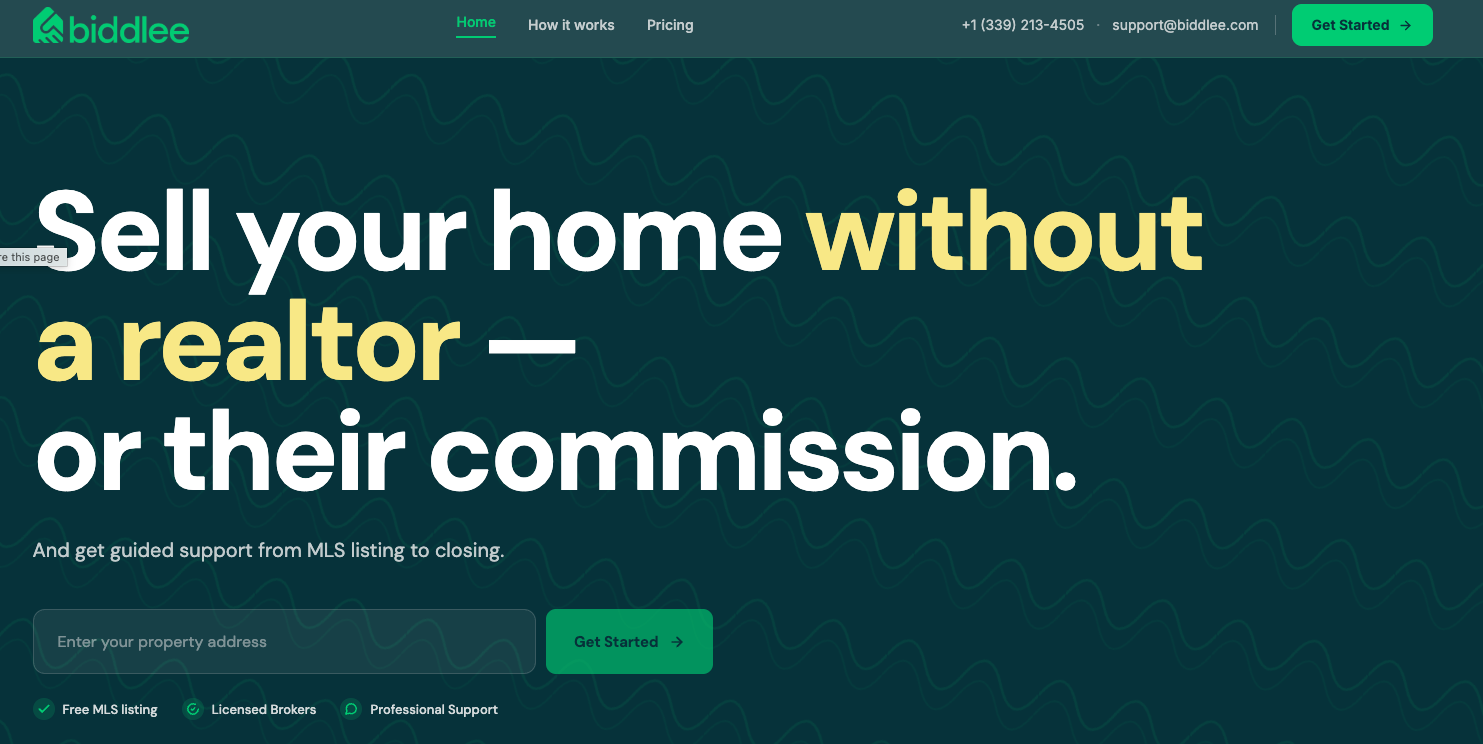
I get why these MLS-only companies would claim that all you need is broad exposure. I understand why portals would claim that all you need is broad exposure. I don't understand why a working REALTOR would claim that. For what it's worth, my AI doesn't claim that: Claude tells me to talk to a REALTOR, but a REALTOR tells me that all I need is syndication? Huh.
Anyhow, we then get this:
No seller ever called an agent to ask for less marketing. In The Real Brokerage’s March survey of more than 400 agents, 69 percent said not one client had ever requested it.
The demand isn’t coming from sellers — it is supplied by brokerages, and every reason behind it is theirs, not the seller’s.
I gather we are supposed to simply ignore that 31% of agents surveyed apparently did say that at least one client did request less marketing? If you can't tell the difference between "no seller ever" and "69%", an easy way to understand is to tell your spouse these two sentences and measure reactions:
- Honey, I have never cheated on you even once.
- Honey, I have not cheated on you 69% of the time.
But let us continue, because Ailion then claims:
Which is why no amount of runtime closes the gap. Informed consent is not a signature on a form, nor a seller’s bare preference the market should be free to honor. It is a fiduciary standard. The person obtaining consent cannot be the one who profits from “yes” — plenty of mothers can tell you a C-section sometimes gets scheduled more for the doctor’s calendar and the hospital’s margin than for the health of mother or baby. [Emphasis added]
Wait a minute... when did real estate agents stop charging commissions? If the person obtaining consent cannot be the one who profits from "yes" then every single listing and buyer agency agreement is null and void and a breach of fiduciary duty, no?
If I call the Ailion Team to list my house, will someone from Keller Williams show up and urge me to sign a listing agreement paying Ailion Team 3% of the sale price? Will this fiduciary who cannot profit from my yes also tell me about Biddlee and Houzeo and a dozen other MLS-only firms as a possible option to listing with the Ailion Team? If I do decide to sign with Ailion Team anyhow, and an offer comes in, will someone not from the team present the offer and urge me to take it, since Ailion will profit from my "yes"?
Yes, the examples are ridiculous, because the standard articulated is ridiculous. It seems fair to expect better from an attorney. Fiduciary duty does not mean not-for-profit, unless Georgia has a different understanding of fiduciary duty than every other jurisdiction in the common law tradition.
Ailion ends with this;
The cost has to be named and quantified. And consent to a default the seller never sought is not consent at all. The National Association of Realtors’ own policy already requires sellers to sign a disclosure acknowledging the exposure they are giving up. The form exists. The only question left is whether we treat it as a box to check or a duty to discharge.
And that duty is already written down. The Code obligates us to protect our client’s interest and to cooperate with other brokers unless cooperation is not in the client’s best interest. A private exclusive is defensible only when not cooperating genuinely serves the seller — proven by real, informed, seller-originated consent.
Everything else is a business strategy wearing a consent form.
Funny that Ailion should mention NAR policy. I wonder if he's aware of the latest NAR policy on the question.
The NAR Policy and Fiduciary Duty Requirements
I wrote about the new NAR Policy on private listings here. One of the things I openly wondered about is how this applies:
BROKER’S ROLE AND RESPONSIBILITIES
Before entering into an office-exclusive listing or using a pre-marketing option (where available), it is imperative for the listing broker to:
1. Explain all listing options to the seller—including how each aligns with the seller’s goals, marketing strategy, and critically, how each option serves the best interest of the seller. If the seller chooses to market their property as an office exclusive exempt listing or utilize a premarketing option (if available locally), the required disclosures must be executed.
2. Secure a seller disclosure form. This ensures the seller’s understanding of their options, the benefits they’re waiving and confirms their decision.
Since NAR relies on Article 1 of the Code of Ethics, which Ailion also cites above, I do not understand why this applies only to "office-exclusive listing or using a pre-marketing option." Why wouldn't this duty to protect and promote the interests of their client apply to all listings?
The answer of course is that the duty to protect and promote the interests of the client apply to all listings, to all situations, in which the REALTOR is assisting the client in an agency capacity. Period. And even in Florida where transaction agency is the norm, the Code of Ethics still applies if you are a REALTOR.
Which is why I asked:
As an aside, does "explain all listing options to the seller" include briefing the seller on the benefits of office exclusives and pre-marketing, as well as the possible downsides of listing in the MLS as an active listing from day one? Does the broker or agent now have a duty under Article 1 of the Code of Ethics to lay out the case even for marketing methods they do not like?
If Ailion takes his duty to disclose seriously, then presumably he has to get informed consent from the seller on putting his home in the MLS as an active listing on day one. Fiduciary duty requires it. The Code of Ethics requires it.
Ailion argues the point himself:
The cost has to be named and quantified. And consent to a default the seller never sought is not consent at all.
How are we to know the seller ever sought active listing on day one? Every single time I sold my home, the agent never once explained the pros and cons of listing in the MLS, of syndication to portals, of putting my property on IDX feeds for all sorts of websites to display. The default is not something I sought, is not something the agent explained to me, and yet, I just signed the listing agreement. Have I been taken advantage of, urged by the party who profits from "yes" to push a corporate growth strategy?
Lest we forget, let me make the point clearer on what the Code (and the law if fiduciary duty attaches) requires by paraphrasing Ailion directly:
And that duty is already written down. The Code obligates us to protect our client’s interest and to cooperate with other brokers unless cooperation is not in the client’s best interest. Hiding a private exclusive is defensible only when not cooperating genuinely serves the buyer — proven by real, informed, buyer-originated consent.
If Ailion is working with a buyer, he needs to inform the buyer that there may be private listings on Compass.com and that the buyer needs to go look at those. His distaste for them is immaterial; his hate and fear of Compass doesn't matter. Informed consent and disclosure are what the Code and the law require.
"Watch How Quickly the Debate Collapses"
That phrase was one of the most amusing from the op/ed.
After writing that, and after acknowledging my work on informed consent, Ailion never even mentions it again. So allow me to mention it, or rather repeat big chunks of it.
The key aspects of a lawyer's duty to explain, to inform, and to get informed consent are:
- Explain in plain terms.
- Identify the material risks honestly, including uncertainty.
- Present the realistic upside without overselling, and the realistic downside without fear-mongering.
- Lay out any alternatives, at least the ones where not knowing about them could hurt the client.
- Ask for questions and actually answer them.
- Verify the client understood the information enough such that he can "participate intelligently in decisions."
- Do not assume the client knows something that seems obvious to you, the professional.
I think real estate agents should adopt the same standard. Further, I think real estate agents should also adopt the duty of competence, which requires doing work to be informed themselves. Just taking CE classes is not, I'm afraid, good enough.
I further believe that the duty of competence requires independent judgment. Each agent has a duty to come to independent conclusions about a topic, especially one as fraught as private listings. She can't simply take her broker's word as gospel, nor just go with the vibes on social media. She has to educate herself on the issue independently and come to her own independent judgment on it.
The debate collapses not because Ailion asked the one question that matters, but because he refuses to answer it or engage in it.
Asking the one question that matters (if it is "informed consent") means a whole lot more than just repeating tired old talking points about "client's best interest" without even attempting to ascertain what that might be and how one might go about determining it.
The Reasonable Person Standard
Since Ailion refused to engage in the one semi-interesting legal point he brought up, let me do it. It is a complex topic, but let me attempt to simplify it as much as possible.
For starters, the "reasonable person" standard is a legal fiction invented to make life easier for judges. It allows judges to skip over the particularities of this particular person (defendant, plaintiff, etc.) and think about a hypothetical everyman: "a person of ordinary prudence, judgment, and care." Not an expert, not a specialist, not an idiot, but a hypothetical average person.
There is a split in American courts around "informed consent" and "reasonable person." Most of the decisions come from medicine. Half apply the "reasonable physician" standard and ask what a hypothetical average medical professional of ordinary prudence, judgment, education and care would tell a patient. The other half applies the "reasonable patient" standard and ask what a hypothetical average patient would find important.
It is clear that Ailion sides with the "reasonable patient" standard:
Would the average, reasonable, fully informed seller agree to a marketing strategy that tends to lower their net price, lengthen their days on market and pay their own advisor more?
That Ailion begs the question, and has failed to educate himself on the current state of the debate, is obvious. Because there are now studies, including at least one neutral study, that appear to show that private listings raise the net price, shorten DOM... and pay the advisor more by way of a higher sales price.
Maybe he doesn't agree with those studies, which is fine, since I'm sure the proponents of private listings don't agree with studies from Zillow and various MLSs. But both have a duty to be informed about them and to inform clients about different findings from different studies.
That this failure to inform himself is itself a failure of fiduciary duty of providing informed consent should be noted. If Ailion has studied the issue, and came to an independent judgment, we see no sign of it. That Ailion must inform any client of the debate, and provide his rationale for his independent judgment should be obvious.
"On the one hand, private listings might do XYZ, but on the other hand, there are these negatives. I think the negatives outweigh the positives, and here's why I think so. But the same applies to active listings: there are pros and cons, and my judgment is this, because of these reasons."
That is what informed consent requires, whether we're talking about the "reasonable agent" or "reasonable seller" standard.
Is that what we see here? Not at all. The conclusion is entirely foregone, and Ailion functions not as an advisor providing information for the client to make an informed consent decision, but as a zealot pushing for an predetermined outcome.
Which is fine to do in an Inman Op/Ed pushing a point of view to the industry. As long as he doesn't do it to an actual client, I have no objection.
Wrapping Up
Actually, I do have an objection as a participant in public debate and discourse on the topic.
It simply won't do to post an op/ed claiming that asking one question settles the debate... then failing to make anything resembling an argument.
This is turning out to be a rather common problem with those on the anti-private listings side of things. They make broad unsupported claims about seller interest, about corporate strategies, about whatever emotional fear-mongering self-righteous bullshit.
I think I can understand why. Bruce Ailion lets the mask slip in his post. He writes that demand isn't coming from sellers, but from brokerages because private listings would give them:
- Listing control: We hold the motivated buyers the other firm doesn’t.
- Buyer control: Those buyers have to come to us to see the inventory.
- More money: Compass’s own internal documents show its off-market deals double-end at a rate 72 percent higher than its public listings.
- Recruiting: You can’t beat our inventory, so join us.
- Retention: Leave, and you lose the advantage your own listings helped build.
That may be the case, but it is completely irrelevant to a seller. Why the hell do I care if Compass double-ends a deal, or has an advantage in recruiting? I just want my house sold for a price and terms I find acceptable. I don't give a shit if buyers have to go to someone or another to see inventory; I just want my house sold. The corporate competition within real estate is of zero interest and zero relevance to me, the seller or the buyer.
They only matter to me if the corporate market-share grabs affect me, and whether they affect me or not is entirely dependent on the whole informed consent debate. Which is the precise debate Ailion doesn't want to get into.
That a RE/MAX agent is fearful of Compass or any other brokerage engaging in private listings for the above reasons is understandable (well, at least until Real/REMAX embraces private listings themselves) but has no relevance to either informed consent or the reasonable person standard.
So here's the deal, as far as I can tell.
If you want to debate internal industry issues and competition methods, then do that. There are real arguments to be made on both sides.
If you want to debate fiduciary duty, client interests, and consumer harm, then do that. But make some actual arguments, instead of emotional manipulations based on nothing but your own feelz.
Please don't mix the two together.
-rsh