
I just got back from Inman San Diego. Well, more accurately, I got back from #lobbycon at Inman San Diego, which has been my preferred way to "do Inman" for a few years now.
Tom Bohn, the new CEO of Inman, has put together an advisory council and a number of my friends and colleagues are on it. They were, I assume, very helpful to Tom. I am not on that council, but I do care about the industry and industry conferences. I may use Inman as an example, but I am not picking on them by any means; Inman is just one example as it is the flagship industry event. Or was.
This is a public post, because I do think many of my readers find themselves attending at least a few industry events every year at significant cost in time and money. I know many wonder why they bother.
So let's talk about it.
What Is the Point of a Conference?
We might start with a simple question: why attend any industry event? Forget real estate for a second. Imagine you're in some other industry. Say you're a lawyer, or a computer programmer, or a gamer. Why attend any industry event at all?
I can't speak to every industry and every event, of course, but over my almost four decades as an adult, I have attended quite a few events in disparate industries. Turns out, they tend to have different focuses.
For example, legal conferences tend to focus on education and on... what to call it... taking action. They tend to cover latest developments from court cases, rulings, regulation changes, etc. A sub-segment is to urge attendees to a particular interpretation of the law, or to take some kind of action. That makes sense if your attendees include judges and regulators and such.
Medical conferences, based on conversations with doctor friends, are almost entirely focused on the latest research. Academic papers are presented at many of them, as well as clinical trial results, sharing a new technique for treating a particular health problem, etc.
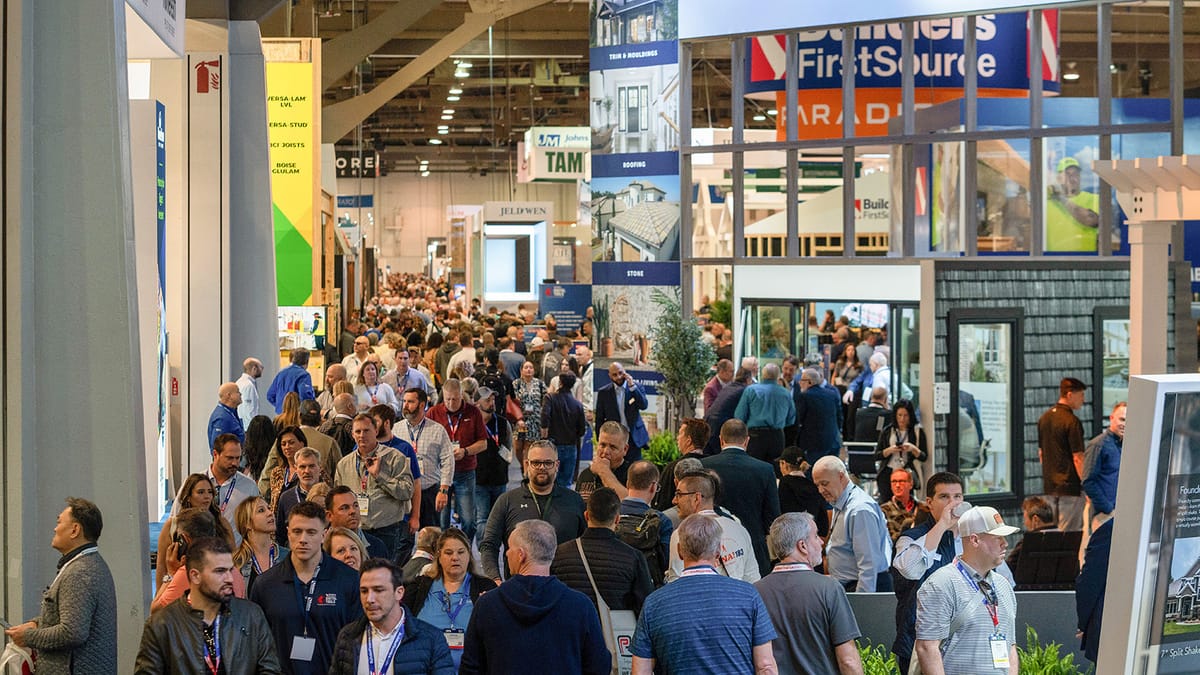
Other shows are almost entirely focused on new products and vendors. I have attended IBS (International Builder's Show) and nobody cares about or goes to sessions. They go to IBS to see vendors and to see new products. SHOT Show is identical. The biggest firearms industry trade show isn't about sessions or speakers or panels; it's about what new firearms and accessories vendors are introducing.
I have attended and participated in one conference hosted by an investment bank. That was very similar to SHOT or IBS. The point of attending is not some session on capital markets trends. The point is to meet with various companies, hear their CEOs expand on earnings calls, answer questions, etc. It is a bit like shopping for products, if what you buy is shares in public companies.
Some events are focused on action. Political parties, for example, get together to make decisions and to vote on things. Selecting a candidate is an obvious example. NAR Midyear is actually a great example of a conference whose core purpose is to take actions by meeting with legislators and staffers, as well as to vote on various proposals.
Thing is, for an industry event to have value, there has to be something in it that either can't be done, or is much more expensive and time consuming to do, without coming together in one place at the same time. IBS is a good example of this. Sure, Weyerhauser can and does contact every single builder to pitch some new building product. But it's easier, cheaper, and more efficient to go to IBS and pitch thousands of builders over the course of a few days. Lawyers can and do read up on latest case rulings, changes to regulations, and have meetings and continuing education and all that. It is easier, more efficient, and more influential to speak to an entire audience of lawyers on the latest antitrust ruling from the Ninth Circuit.
One way to think about it is to ask this question: What scarce form of industry progress can an event concentrate on?
Real Estate Conferences
If we're going to be honest, the problem with real estate conferences is that they are not focused on any of the above. There is no scarce form of industry progress that any event concentrates.
Instead, what we have is a mish-mash of networking, people opining on stage, repeating the same topics over and over again with zero action, some education that can usually be gotten elsewhere more effectively, some broad information sharing, some vendor space (but often limited and inconvenient), and mostly a weird kind of ego-stroking on stage.
For example, this is an event from Inman San Diego that just passed:
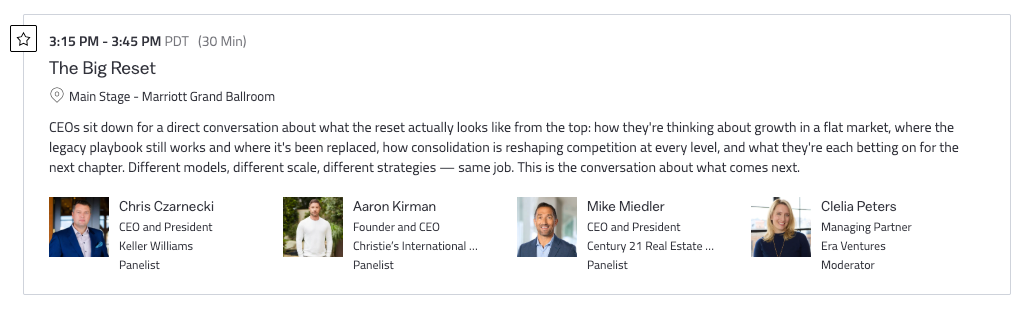
Who is this for? What does this accomplish? It's not education precisely. It isn't a presentation of research on "how consolidation is reshaping competition at every level" backed up with data and graphs and charts. How the CEO of Century 21 is thinking about growth in a flat market is relevant to Century 21, but if you're a small indie broker, what relevance is that to you? Is the CEO of Keller Williams going to really spill the beans on what they're actually doing to recruit agents or generate leads? Public company executives are going to talk about their internal strategies?
What did I miss by not attending this session? What did anybody miss by not attending?
Or this training/education session:
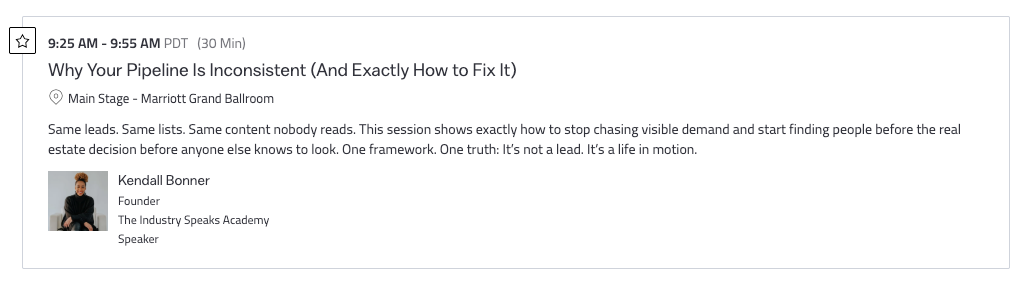
Why bother coming to a conference for this? Kendall Bonner has a coaching/training company: The Industry Speaks Academy. Why not just go there and learn from her? If you just want to know what she offers, wouldn't a YouTube video be more useful than sitting in a hotel ballroom? Like this one from her channel?
To make it obvious that I am not picking on Inman, here's the HousingWire AI Summit (using the same conference software apparently, so it looks the same as Inman):

This might be useful if it weren't Josh Miller, CEO, speaking for 15 minutes but the people who actually build the AI tech speaking for 2 hours, with a computer showing their code, the AI prompts they used, the database they connect to, the MCP server setups, etc. In other words, if Epique wanted to open source their tech stack live in front of a developer audience, that would be useful education.
It's kind of what doctors do at medical conferences, after all.
Can't be done in 15 minutes by the CEO, however.
So the truth is that people go to real estate conferences mostly for networking, for business meetings, to get face to face with clients and prospects, and for the parties and the dinners after hours. You don't actually need a conference with a $895 ticket price for that. You need #lobbycon for that.
Free Advice to Inman
I believe I went to my first Inman in 2008, because that is also when I attended the very first RE BarCamp. At the time, Inman's tagline was "Where technology meets real estate." It was in San Francisco because that was (and kinda sorta still is) the tech hub of the world.
Look at the Inman agenda today and tell me if you think it's still where technology meets real estate. It is not. It's not clear what Inman is today.
Yet... real estate is absolutely obsessed with and ravenous for technology. The average real estate agent or broker would much rather find out about some new tech product than listen to three Big Real Estate CEO's brag on stage about how great their companies are.
My free advice to Inman, therefore (worth what they paid for it) is to pivot to becoming IBS for real estate. Meaning, focus on vendors and products. Don't be hostile to them like you have been in recent years. Nobody cares about yet another panel discussion on AI. They would rather see every company building AI for real estate on the vendor floor and go find out what each one is offering.
Inman, of all real estate conferences, should become a trade show. Drastically cut ticket prices, so the average broker or agent could attend just to walk the showroom floor for a day or two and find out about technology that just might help their businesses. Figure out a model for vendors of all sizes to be able to participate, because what Inman brings to the table is the ability to speak to thousands of people about your product – and for potential buyers to see every tech product for sale.
If you must have sessions at all, then make sure that every speaker is from a tech company pitching a solution to real estate. The hostility we have in our industry to vendors is kind of ridiculous; just make it very plain that we are listening to a sales pitch is all we ask. And the ability to leave whenever we want.
Free Advice to Everyone Else
Other events have their core identities too. They should focus like a laser on that. What value is there for people to come together that they can't get as easily elsewhere, for example, via Zoom?
T3 Summit brings together 400 C-suite executives from across the industry. That's a fantastic opportunity for presenting real academic research. Your audience doesn't need another motivational speaker on leadership; they are already leaders likely giving those speeches. They don't need some profile of a CEO; they are CEO's themselves. What they need is information on and ability to discuss strategic issues: economy, demographics, government policy, big tech impact, etc. Focus on those things, and avoid the obvious things that the DOJ would care about when 400 C-suite execs get together in one place.
Other events like CMLS and RESO and MLS Reset have far too many speakers and panels. They should consider becoming action-oriented conferences instead. Those events should be much more interested in hearing from the audience, rather than speaking to them. Those should be geared towards voting and making decisions on big topics. If all decisions are made by the Board, then at least have the conferences be the place where members can challenge the Board, ask questions of the Board, and provide feedback to the Board. That would be useful. Because yet another panel discussion on MLS consolidation is entirely pointless; it would be more impactful to have live auctions instead where big MLS can bid on smaller MLS for purchase.
Let me end there, since I can't actually provide useful advice without knowing the particulars of your event.
Focus, Focus, Focus
As a way of wrapping up, let me suggest that every real estate conference learn to focus. It doesn't matter whether you are Inman or a local REALTOR Association doing a member day.
Far too many people just spread the net wide to try to appeal to all kinds of possible attendees. Local MLSs have vendor showcases, continuing education, training classes, and motivational speakers. It would be far better to pick a lane and focus on that.
And always ask that all-important question: What scarce form of industry progress can your event concentrate?
-rsh