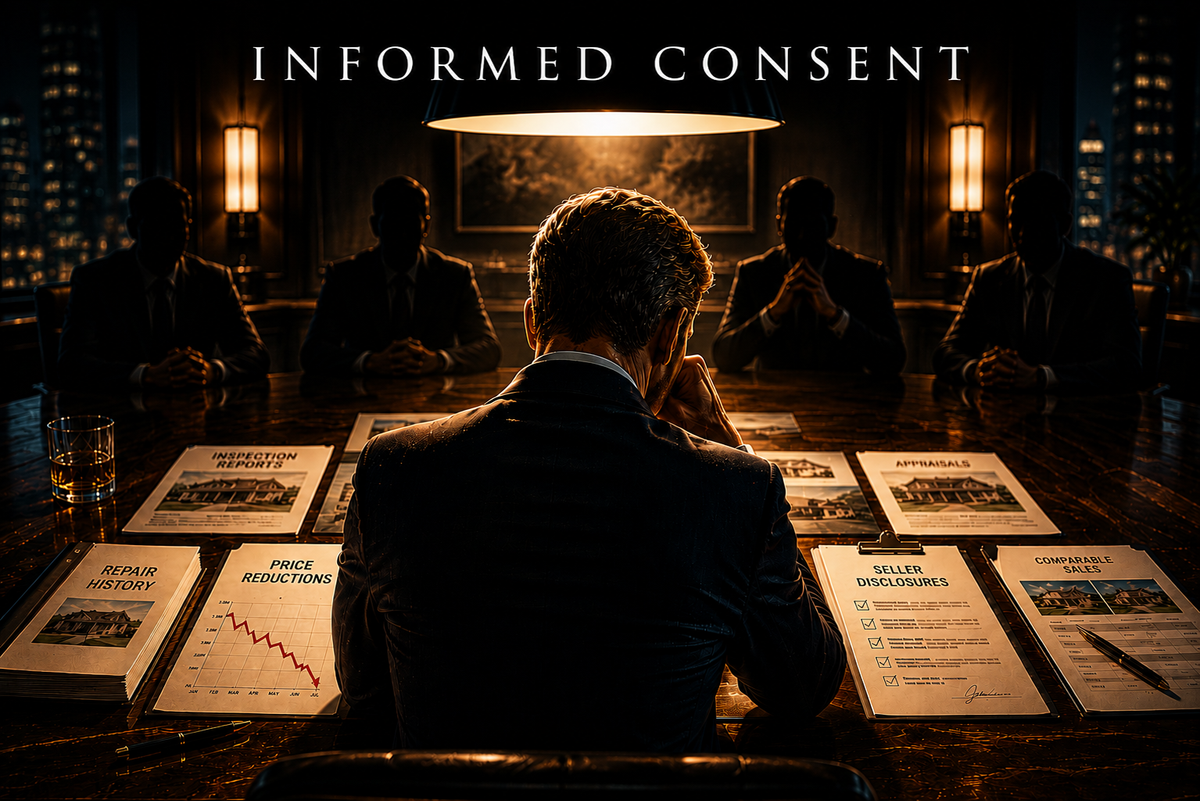
Rob's piece on Informed Consent is important and timely. But don't forget, it cuts both ways.
By Greg Hague
[This post has not been edited at all, and presented exactly as the author wrote it. It is a public post.]
There’s a word doing an enormous amount of work in our industry right now, and almost nobody has stopped to ask whether it’s earning the wage.
The word is private.
Say it out loud and notice what it does. Private. It arrives carrying a century of meaning: hidden, exclusive, behind a velvet rope, not for the likes of you. The word makes the argument before any argument gets made. And in the fight over how homes get marketed, one side has quietly figured out that if you can get everyone to call a thing “private,” you’ve already won. You don’t have to prove a listing harms anyone. You just have to name it, and the connotation does the rest.
Now, Rob’s post on informed consent is, to my mind, the most important thing written in this entire debate, and I’m not saying that to be kind. He’s right that real estate should hold itself to the standard lawyers hold themselves to. He’s right that silence is not consent, that a signed form is not understanding, that a client nodding along has agreed to nothing at all.
But the standard Rob advocates has a feature worth noticing. Once you accept it, you cannot apply it in only one direction.
The worry he names, fairly, is that some agents push “private” listings as a program and dress it up as choice. That’s real, and it’s a genuine informed-consent failure. An agent who hasn’t thought a thing through can’t possibly help a client think it through. Agreed, completely.
Now, turn it around.
If informed consent requires us to disclose the downsides of keeping a home off the major portals like Zillow, then it requires us, with precisely the same force, to disclose the downsides of putting it on them. You can’t owe a client the whole picture and then hand them half of it and call it done.
And those downsides are real. Some of them can’t be undone. The MLS, for all its genuine value, starts a clock the instant a home goes live, the days-on-market counter that member agents read as proof a home is stale and a seller is desperate, often when neither is remotely true. It keeps a permanent, visible record of every price change. A seller who tests the market and adjusts once can wear a scarlet letter that says “reduced” and whispers “desperate.” We don’t disclose any of that as a risk. We treat it as simply the way things are done.
Zillow takes it several steps further, and this is where the informed-consent question gets genuinely uncomfortable. When a buyer clicks the Contact Agent button to ask about a home on Zillow, where does that buyer go? Not to the agent who listed the home and walked every room of it.
The buyer is routed to an agent who paid Zillow for the introduction and who may have never set foot inside the property. The buyer who just read the full description and studied every photo frequently knows that house better than the person now positioned to “represent” them. And that agent’s first order of business will be to get the buyer to sign an agreement to pay them, often tens of thousands of dollars, for the privilege of seeing and buying a home the buyer found entirely on their own.
Ask the question Rob taught us to ask. Does the seller understand that’s how the most popular “public” channel really works? Does the buyer? If informed consent means anything at all, isn’t that disclosure every bit as mandatory as a warning about going off-portal?
Which brings me back to that word. Because here is what almost nobody says out loud. A home marketed off the MLS and off Zillow is not hidden. It is not “private.”
There are more ways to put a property in front of serious, qualified buyers than there have ever been in the history of this business. They include multi-agent, multi-brokerage networks tens of thousands of agents deep, social platforms with a reach the MLS can only dream about, and a brokerage’s own heavily trafficked website.
Even Compass’s Private Exclusive, in its first phase, simply asks a buyer to say who they are before it shows them the photos, the floor plan, the art on the walls, and the address of someone’s home. That isn’t a vault. It’s a doorman. Calling it “private” in the sinister sense isn’t analysis. It’s branding, and effective branding at that.
So let me say what I think this fight is truly about, because it isn’t about private versus public, and it isn’t about whether sellers want exposure. Of course they want exposure. Nearly every seller wants as many qualified buyers as possible. That was never the question.
The real question is whether the very first channel a seller reaches for should be one that quietly arms the buyer against them, brands the home with a clock and a price-cut ledger the moment it appears, and hands the buyer’s interest to whoever paid the most for it. Those aren’t neutral features. They’re design choices. And they were designed to serve the portal, the platform, the institution, not the everyday seller trying to get the best price or the everyday buyer who thinks the button reaches the person who knows the home.
There’s a reason Zillow shows all of it: days on market, every price cut, offer guides that supposedly hand a buyer the odds of landing a home below asking. It isn’t generosity. Those tools draw buyers, and buyers are precisely what Zillow monetizes, by selling them as leads to agents who pay for the introduction.
The irony I can’t get past is this. Zillow is itself a licensed real estate broker in most states. If the duty of informed consent applied to Zillow the way it applies to the rest of us, Zillow would have to sit its buyers down and disclose its own downside, that the button doesn’t reach the agent who knows the home, that the lead has been sold, that representation is about to cost them real money.
It will surely argue it owes no such duty, that the obligation belongs to the agents it refers out to. Convenient, for the single party in this arrangement that touches the most consumers.
Now let me be as transparent as I’m asking everyone else to be. Informed consent runs to my readers too. I know, admire, and talk with Robert Reffkin, and I help agents across his various real estate brokerage brands. I also believe deeply in his case for marketing freedom. So weigh what I say accordingly.
In a nutshell, here’s what I believe. There is real, repeatable upside in marketing a home aggressively before it ever lands on the MLS and the portals. An early buyer who feels like they got the first look, who doesn’t see a trail of buyers who passed before them, who senses they’re beating the crowd rather than joining it, behaves differently than a buyer scrolling listing number forty on a Tuesday night.
They make stronger offers. Not always. But often enough that I’ve watched it happen thousands of times. Why on earth wouldn’t a seller want to see those offers first, with their agent’s honest counsel beside them, and then decide, eyes wide open, whether to take one or go wide on Zillow and the MLS and accept everything that comes with them? Test the strong offer. If it isn’t good enough, you’ve lost nothing you can’t still go out and get. That’s not a trick. That’s leverage. The seller’s leverage, used for once in the seller’s favor.
Rob, your informed-consent post is among the best you’ve ever written. My one fear is that it gets interpreted in one direction. That brokers walk away certain the lesson is “warn sellers about the dangers of the evil private listing,” and stop right there. Because that reading smuggles the whole con back in through the side door. It quietly casts one option as the risk and the other as the safe default, when honest informed consent has no default. It has options. Each with an upside and a downside, laid out plainly, the client understanding both well enough to choose for themselves.
Private listings are neither evil nor private. They’re just homes, marketed by sellers who, given real informed consent, understood the irreversible downsides of the channels they might otherwise have chosen first. That isn’t a hole in your argument. It’s the logical end of it.
Informed consent cuts both ways. If we’re going to demand it, let’s have the nerve to demand all of it.
Greg Hague is an attorney, 50-year real estate veteran, and the founder of 72SOLD, recognized by Inc. 5000 among America’s Top 250 fastest-growing companies. Greg was ranked the #1 agent in his state and #19 nationally by REALTOR® Magazine. He has been featured in Forbes, The Wall Street Journal, Housing Wire, Inman News, and interviewed on every major television network.