
As some of you may know, I recently launched a new dating website with Sunny that we think is maybe needed in our current social climate. It's called Seony, and is currently live and in very much of a beta phase.

It's a dating site for parents to make connections for their adult children. We thought online dating culture is broken in America and thought perhaps the Korean tradition of seon might be an interesting approach to the issue. Go visit Seony if you want to know more, since this post isn't about that.
As a result of trying to launch an online dating website, I have had to do some research on how dating website work. One of the most interesting things I came across during that research was into how people actually use them.
It turns out, how people use real estate websites tracks almost exactly with how people use dating websites. The similarities are striking.
Those similarities can and should inform how we think about online marketing of real estate, and might offer a reconsideration of how we've been doing things for a couple of decades.
This will be a public post as I think it worthy of wider discussion and debate.
How People Use Dating Websites

There is a fair number of academic research done about how people use online dating websites. One key study appears to be this one by Tess van der Zanden and a team of researchers in Europe titled "What People Look at in Multimodal Online Dating Profiles: How Pictorial and Textual Cues Affect Impression Formation."
Long story short, the researchers used eye-tracking technology to study how people actually form impressions from dating profiles. What they were trying to figure out is just how dominant photos are in attracting initial attention. There is a volume of literature studying that topic, which seems rather... obvious. The hotter your photos are, the more attention you get.
What's more, the academic literature confirms what most people intuitively grasp:
Once an overall initial impression about a profile owner has been formed based on picture attractiveness, people may or may not proceed to put more effort in pro-cessing other available profile information, such as the profile text. If the initial impression about physical attractiveness is strongly valenced, that is: very positive or very negative, little further information processing may be needed, because phys-ical attractiveness is such a strong determinant of perceived attraction in (online) dating. After all, people are willing to date highly attractive others anyways (Walster et al., 1966), whereas profile owners with unattractive pictures will presumably be excluded as potential partners based on the picture information that has been evalu-ated first (Fiore et al., 2008).
This implies that a profile owner’s physical attractiveness, as depicted in the profile picture, may function as a “gatekeeper” to the rest of the profile: picture attractiveness can determine to what extent profile texts receive attention in addition to the profile picture. This not to say that people will not look at the profile text at all when seeing an attractive or unattractive picture, but that relatively less attention will be paid to the profile texts.
In plain English, if the photo is super-hot or not-at-all-hot, then users don't bother reading any of the profile information. They either just skip to "swipe left" or skip to "swipe right" based solely on the photos.
When someone evaluates a dating profile, their eyes go to the photo first. They hold there. In one study faces accounted for 83 percent of total gaze time, regardless of whatever else was on the screen.
Then the eyes move to the text, read it, and travel back to the photo. The whole pass takes about eleven seconds. Fast intuition off the picture, slower reflection off the words, and a decision that blends the two before the user has consciously decided anything.

The above is from their study showing where user's eyes go (numbers), and how long they stay there (size of circle). 1-9 are on the face, then 10 goes to the text. Then 62 goes back to the face, as if the user read her profile and is trying to decide whether she's hot enough (or not hot enough) for a decision.
Again, seems entirely intuitive.
How People Use Real Estate Websites
Now... it turns out, there are academic studies of real estate website users using the eye-tracking technology to see what they focus on. I found this study from 2011 titled "Toward an Understanding of Real Estate Homebuyer Internet Search Behavior: An Application of Ocular Tracking Technology" by Michael Seller and team.
Not surprisingly, it turns out that photos dominate here too:
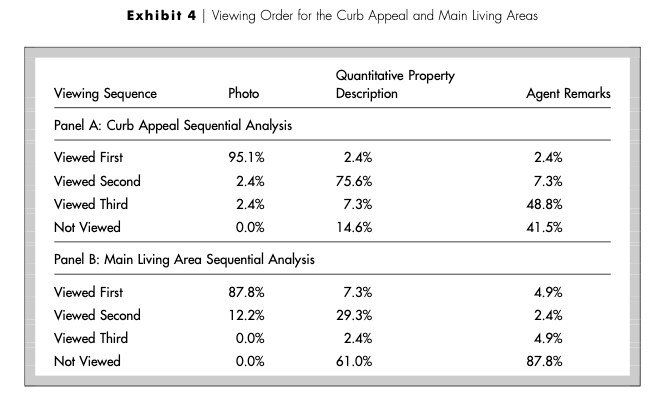
In examining the sequence of each component of the webpage that is viewed, the photo is overwhelmingly viewed first, followed by the property description section, and lastly, the real estate agent open remarks section. Actual homebuyers pay somewhat more attention to these later two sections when viewing the opening page of the home tour than do students. This may be because students are not actually in the market to buy a home.
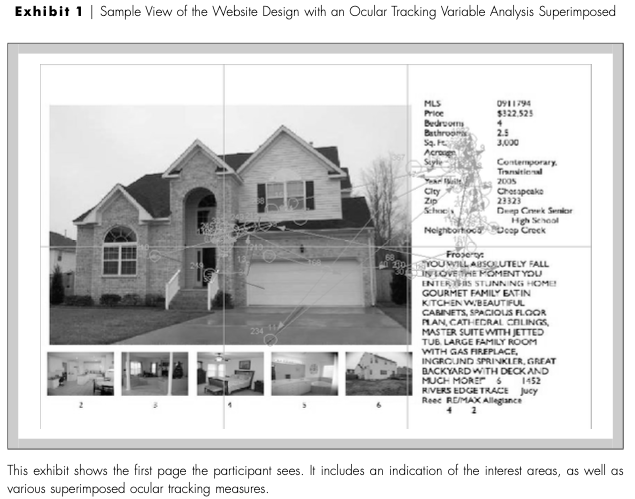
Unsurprising to us, but was new to researchers in 2011 when this study was done, the order of views went like this:
Exhibit 4 displays the sequence in which participants viewed the three sections of each webpage. Panel A reveals the analysis associated with the curb appeal photo, which is always seen first by the participant. Overwhelmingly (95.1%), participants first look at this picture.
After focusing on the photos, participants next turn to the quantitative property description section where the number of bedrooms, bathrooms, square footage, etc. is displayed.
Finally, the real estate agent’s open remarks section is viewed. Very little emphasis is placed on this section. In fact, over 40% of all participants (20% of homebuyers; 62% of students) do not even look at the real estate agent remarks when viewing the first page of the home tour. Participants comply by viewing the remainder of the home, but in an actual setting, one has to wonder if the agent remarks would ever get read if the home searcher does not like the initial photo of the home. [Emphasis and Line breaks added.]
I don't think anyone reading this is blown away by this old study. We all intuitively recognize that what's important on a website are photos, bed/bath/price, and then everything else. Right?
And then we have this study from the UK, where Zoopla used eye-tracking to study where homebuyers spend time looking.
More troublingly, the study revealed that homebuyers were focusing more of their time and attention on superficial details like the current furniture in the property—which will inevitably be removed after a purchase—instead of diving deep into the condition of the boiler or checking for signs of damage or damp around the property.
Trial participants were least interested in flooring, the roof and the ceiling.
They also spent less than half a second looking at radiators, despite their importance to the home's heating system.
Right about now, you're thinking... so what? Who cares? We all know this already.
But there is a very important difference between dating websites and real estate websites.
Purpose of Putting Anything on the Internet
We might begin by asking, "Why put anything on the internet in the first place?
With dating websites, the answer is obvious. You want to meet someone. Have a conversation (message each other on an app I guess). If that goes well, maybe you go on a date. If that goes well, then perhaps it leads to a relationship. If that goes well, then perhaps marriage and kids and the rest of it might follow.
Granted, we all know about hookup culture and Tinder one night stands and the like, but I'm pretty certain that most people putting up profiles on a dating website are at least remotely thinking of going on a date.
Let me grant that it's been years since I've been on the dating market at all. Maybe today there are people who want to craft amazing dating profiles with zero intention of ever going on a date. I suppose that's possible, but it doesn't seem likely. Instagram is where you want to just put up curated photos of yourself to be admired by strangers, not a dating website.
With real estate, what is the purpose of putting a listing on a website? Is it not the same thing? You want to "meet" someone. Get an inquiry and have a conversation. If that goes well, then perhaps it leads to a showing. If that goes well, then perhaps an offer and a contract and a closing might follow.
With real estate, unlike with dating, the initial conversation might involve a representative: the buyer's agent. But still, the point of the listing was to generate enough interest to get to some kind of an inquiry, some chatting, and then a date a showing.
An Actual Hinge Profile
Since most of you reading this are not likely a veteran of online dating, I'm going to assume that you have no real idea of what a dating profile in 2026 has in it. So here's a real dating profile that was analyzed in this blogpost:
You can read the favorable analysis by Style My Profile NYC yourself. But notice what the profile has:
- Six great photos
- Great "I'm looking for"
- Age, Height, Location
- Job Title
- Education
- City, State
- Another couple of short statements showing off her personality along with what she likes
That's it. That's all you get.
You know what's entirely missing?
- How long her profile has been on Hinge
- How her last three relationships ended
- Her final report card from Yale University showing her grades
- If she hates dogs
In other words, there are zero "negative insights" in the profile. There is no extraneous information about her that a single man might really want to know. What's her bra size? How's her driving? Her student debt load? Does she snore? Is she a Vikings fan or a Packers fan? None of that is on the dating profile because the purpose of the dating profile is not to answer every question he might have. That's what the conversation and probably the in-person date is for: to get to know each other better.
The Real Estate Listing
In contrast, let's look at a typical dating profile real estate listing.
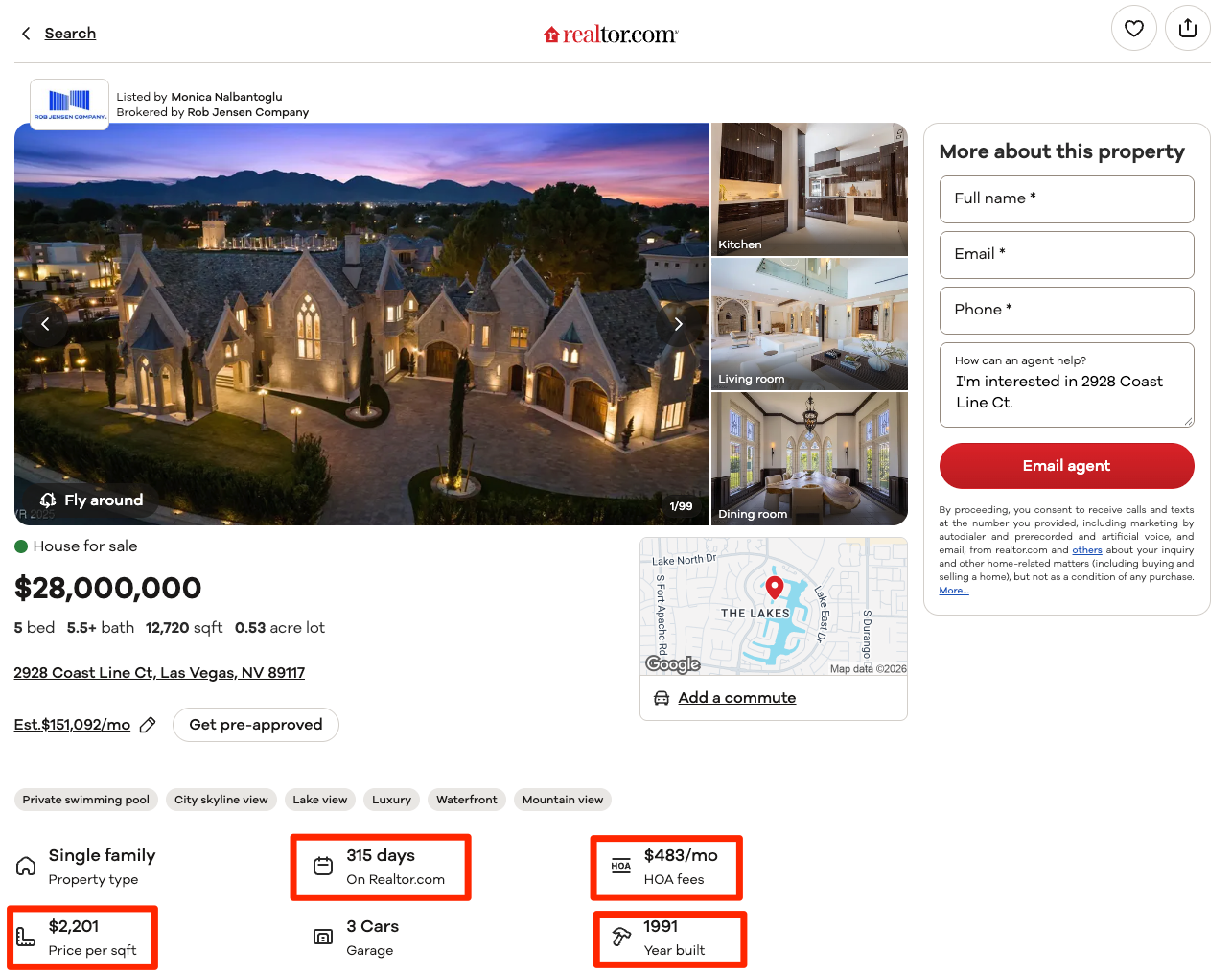
Why are there 99 photos? A dating profile needed six to generate a swipe. Why are we showing 99 photos? Many listings include a floor plan, and others do the virtual 3D tour. Why?
Bed, Bath, Price, Sq. Ft – these are as basic as Age, Height, and Location for a dating profile. Those make perfect sense.
Why is the year built relevant? Price per square feet? (Someone interested by looking at the photos and the price can figure it out... the numbers are right there.) Why is the HOA fee highlighted?
Then we have this:
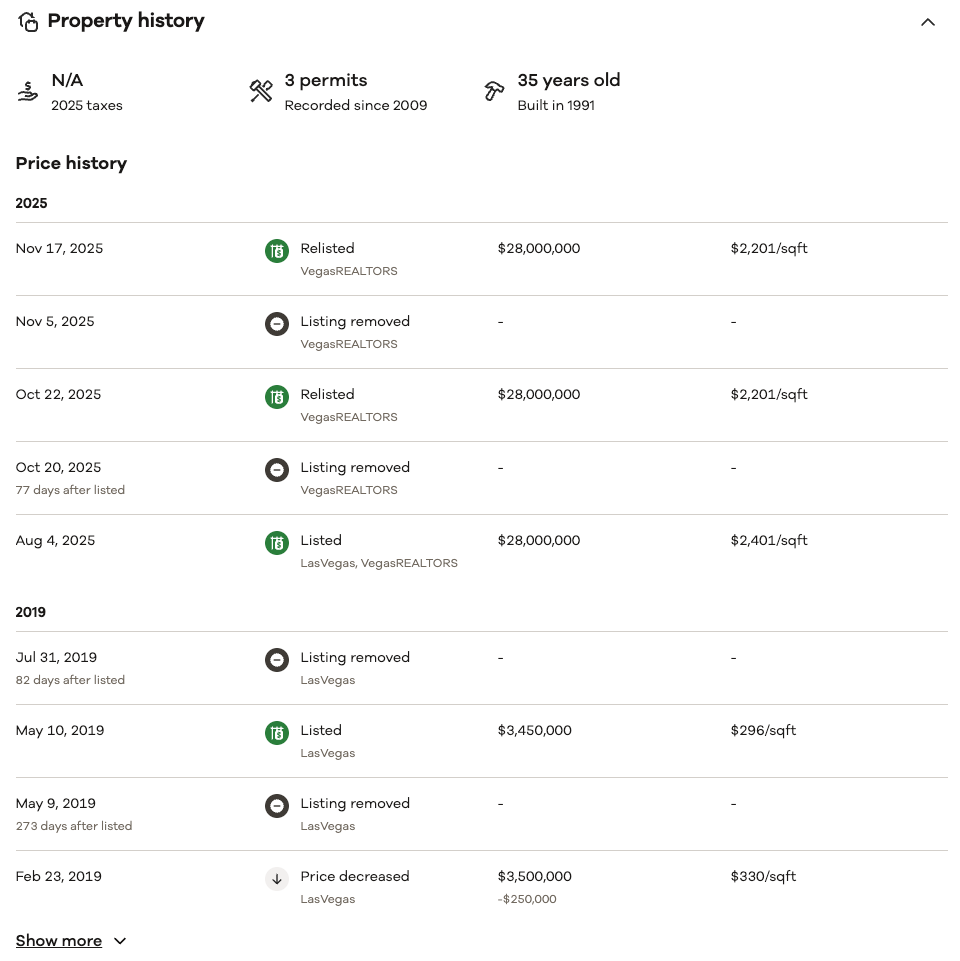
Dating websites do not show the past 10 dates that the person has been on or how many times they've deactivated/reactivated their profile.
- Back on the dating market!
- Broke up with Derek
- In a relationship with Derek
- Dinner with Derek
- Coffee Date with Derek
- Hooked Up with Chad
- Coffee Date with Chad
- Ghosted Clarence
Why are we posting the "dating history" of a house to the open internet? Is this meant to generate attraction and interest?
Then we have this:
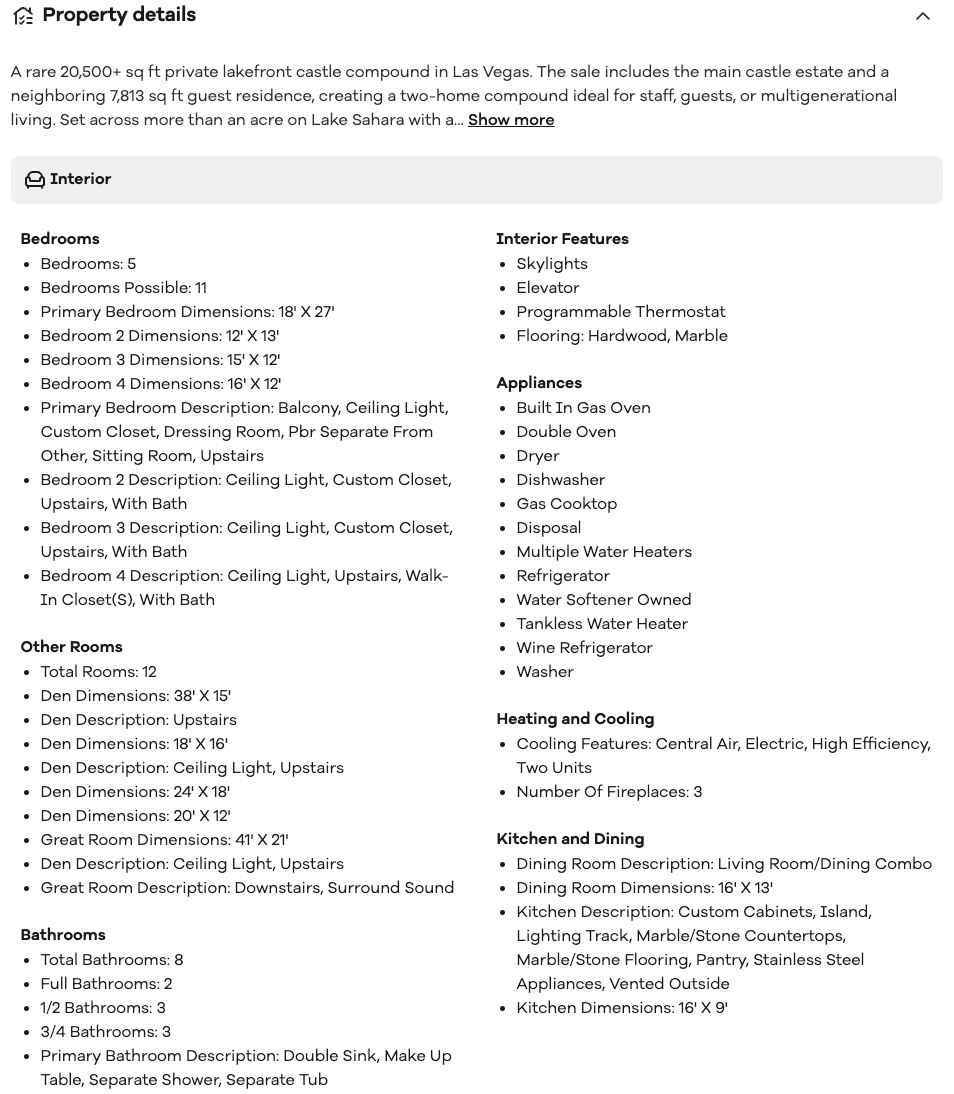
Why is this on a website? The user hasn't even swiped right on you and you're out there telling him about "Programmable Thermostat" and "Wine Refrigerator"?
This is the dating equivalent of you telling the world about what shoes you have in your closet. None of this is necessary, and much of it is harmful to the purpose of your putting your information on a website in the first place: to attract attention, to generate an inquiry, to have a conversation. That conversation might or might not lead to a date, and on the date, you can tell him all about your fetish for halloumi cheese if you want, and your struggle with dieting.
I know, I can already hear someone objecting, "Look, a wine refrigerator is a non-negotiable for some buyers!" to which I say, "Have him swipe right on you first."
Is it too weird to ask you to see if the website user is interested in you before blurting out every single piece of information about you? The user can literally push a button to indicate interest, after all.
What makes this property such a perfect example of the unthinking non-marketing of real estate listings is that this mansion is priced at $28,000,000. In Las Vegas. It has been viewed 2,838 times and saved 59 times.
I rather doubt there are even 28 people in or near Las Vegas or even remotely interested in this desert city who can drop $28 million on a house, let alone the 2,800+ who have viewed it. Plus, people who can afford a $28 million castle do not save properties; they pay executive assistants or managers or lawyers or... imagine... real estate agents to handle such things for them. Nor do they care about wine refrigerators or ceiling lights. They will have their house managers set the place up precisely how they like it.
What are we even doing here?
Marketing vs. Due Diligence
What the above shows us is the difference between marketing and product data.
A dating profile is a marketing object and was always meant to be one. Everyone understands it and has always understood it. The person creating the profile chose the photos. She wrote the bio. She left out her weight and her student debt info and the reason her last relationship ended. Nobody is confused about this. No man in the world has ever declined to swipe right because she didn't provide enough information on her dating profile.
The profile's entire job is to attract the person viewing it to start a conversation. That conversation leads to more surface-level information. You find out who someone is by going on a date. Nobody ever thought, "I think I know this gal from this dating profile."
If the real estate industry understood what marketing actually is, then a real estate listing would also be a marketing object. It would be intentionally put together to make a viewer stop scrolling and book a showing, or at least make an inquiry of some kind. In function, on the screen, it should be doing exactly what the dating profile does.
The eye-tracking technology studies showed how similar dating websites and real estate websites are. People look at photos, then look at photos some more, and then the top-line basic info (Age, Height, Location, Price, Bed, Bath), and only if they're interested further (or the photos are not hot enough) do they read on. They don't read on that much further. They make decisions in 11 seconds, not 11 minutes of deep study into the kind of water heater a house has.
No buyer in history has ever read or cared about "Public Survey Range: 60" or "Parcel Number" of a home on a website. Not one.
The real estate listing was never created to be marketing. It is product data, a professional instrument created by real estate professionals intended to be used by other real estate professionals for professional purposes. Those people care about Public Survey Range and Den Dimensions, because their job is to know those things when their clients ask them.
The listing is the standardized, field-by-field record that a broker provides to other brokers so that they can advise their clients appropriately. Professionals know that other professionals aren't going to be seduced by pretty photos; they look at them (and create them) every single day. Professionals know that they can't hide real information – a lot of it is legally required disclosure. Even if it isn't, they don't want to be the jerk playing hide-the-ball when it might be them representing the buyer on the next deal.
When I wrote about and talked about how we made a mistake back in 2000 with IDX, I was talking about this difference. Because of technology limitations at the time, we as an industry chose to take listing data and repurpose it as marketing. We did not ask whether that is good marketing, or even proper marketing, because it was convenient to just shove what's in the MLS onto public websites.
Since brokers and agents understand marketing themselves, imagine if all agent profiles online were just the real estate licensee record, along with every transaction successful or otherwise, shoved online for everyone to see. They would all throw a fit, and rightfully so. In fact, they did just that when Redfin and HAR.com put MLS agent performance data on the public web.
And yet, they do it every single day with their client's property information.
It is time to stop and correct the mistake.
A Modest Proposal: The Home Profile
I have advocated the end of IDX. It's because of the above. Listing data intended for other professionals has no business being marketing content. (Unless you the listing broker have a specific strategy of using "truth in product" as marketing, which you should clear with your client.)
I propose that we copy dating websites by renaming what is posted on them to "Home Profiles." Just like dating profiles.
No one would be confused by what that means. No one would mistake a dating profile with the full truth about the person, and no one would think that a Home Profile is the full truth about the property.
Everyone would understand that the purpose of the Home Profile is to generate interest, get you attracted to it by highlighting what's awesome about the property, and get you to swipe right on it.
Once you've done that, and have had a conversation with someone about how you're interested, how you have some questions, etc. etc. then maybe the real estate professional on the other end might answer your questions. If it looks promising, then maybe it's time to go on a date and tour the home. That professional might print out the entire listing record and hand it to you; that's her call as a professional. Chances are, that professional isn't going to rely on the listing data as the source of all truth and order an actual home inspection if you get serious enough to want to buy the place.
Is there even a question that a Home Profile would have things like Days On Market and Price History on them? Maybe if the listing agent and the seller think those would help attract inquiries, but if not... I doubt it. The point of marketing is to attract attention after all. And the buyer's agent who you do end up working with can and will tell you all the DOM and price history you'd care to know, because she has access to it as a professional.
What is even the point of letting a random website visitor know that the HOA fee for a $28 million mansion is $483 a month? I don't know what that is, but I do know what it is not: marketing.
Let us be plain that Home Profile requires more work from the listing agent. Now you actually have to earn your keep by thinking about marketing the home. And no, just entering listing data into the MLS and pushing it out via IDX is not marketing a home. Marketing a home means creating attention and attraction with photos, with clever copy, with pricing, with whatever else is legal to do. Some agents are going to be better at it than others. That's a good thing, because consumers will benefit from superior marketing.
With Home Profile being the norm, this would no longer be a thing.
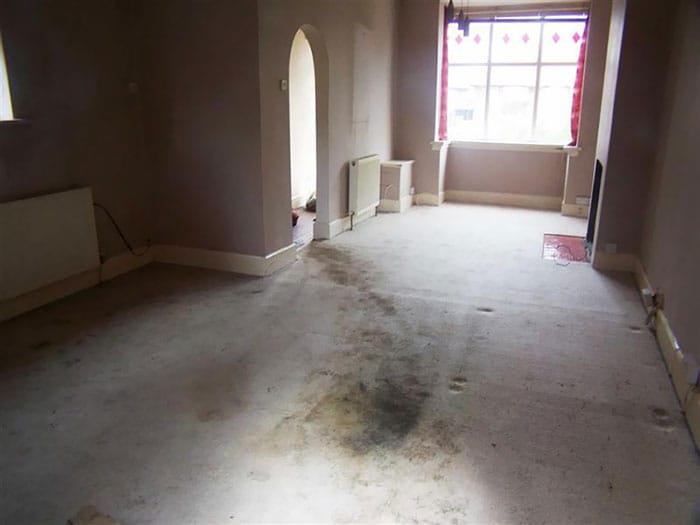
Every single one of those agents would be fired and never work again, which seems like a positive for consumers everywhere.
Conclusion
The academic studies prove that website users on both dating websites and real estate websites behave the same way. They're not interested in every single detail of the person or the house they're looking at. They know that profiles are marketing pieces. They look at photos, and then they look at key topline information like Age, Height, Location, Bed, Bath, Price.
If the photos are not hot enough, then they delve deeper... but only for 11 seconds before deciding.
In both dating and in real estate, if someone is actually interested, they make a move. They swipe right, or contact an agent, or schedule a showing. They hope to find out more, and if they like what they hear, they want to go on a date or walk through the house. If they like that, then they move on to a relationship or a contract.
Listing data was never intended to be marketing; it was always intended to be to inform other professionals about the property so that they can advise their clients properly. That's the entire purpose of the MLS: cooperation between professionals. At least... now that compensation is gone.
Maybe I was over-reacting by suggesting that we eliminate IDX entirely. Perhaps the real move is to make IDX a collection of Home Profiles that brokers and agents create as marketing assets from the very start, and choose to share with one another to put on their websites to draw attention and attraction. Then we might have agents do actual marketing, which many of them excel at doing. Consumers would all benefit from agents doing just that: marketing, not data entry.
Technology is no longer the barrier to marketing homes online. Laziness and institutional idiocy might be. "We've always done it this way!" is not a valid reason to keep doing the wrong thing. "If it aint' broke, don't fix it!" is fine, except that online marketing of real estate is broke.
Could we fix what's broken?
In real estate, as in dating, the deal is simple. Look at the profile, decide if you're interested, then swipe right and start a conversation. And if you want to get to know a house, you should at least go walk through it once. And it turns out that just like in dating, if you really want to get to know a house, you need to make some kind of a commitment... then do your due diligence before tying the knot.
If you're not even willing to swipe right, you get the marketing. You get the Home Profile. Too bad, so sad.
-rsh