

It's Sunday evening as I write this, and once again, I am drawn back into the private listing networks debate because Nick Aufenkamp has written yet another fantastic article: The Faustian Bargain.
I write this to continue the dialogue. My hope is that we all could finally advance the conversation to a useful place instead of the bad-faith name calling BS we've had to endure for a few years now. Because I have friends on both sides of this debate and they're all good people who disagree... but it isn't even really clear what they disagree on. If Nick and I can drill down to our actual points of disagreement, perhaps that can help the industry advance the conversation forward.
With that said, let's get into it. This will be public again because Nick's post was public.
Nick's Piece: The Faustian Bargain
I urge you to go read the whole thing linked to above. Nick is a gifted writer and he articulates his positions extremely well.
I'll begin with his question, "What am I really defending here?"
Nick answers:
What I am defending is a principle: in a market as consequential as housing, consumers deserve broad, timely, reliable access to the core facts driving that market: What’s for sale. How long it’s been available. What the pricing history looks like. What comparable homes have sold for.
The MLS happens to deliver that access to the public today. It wasn’t designed to, but through IDX and syndication, it does. That’s the outcome I care about. But for me, the institution that produces the outcome is negotiable.
Which means Rob’s status-quo framing misses the nuance of what I’m actually arguing. I’d gladly trade the current MLS for something better. What I won’t do is trade it for something worse and call the trade ‘restoration.’ [Emphasis added]
This is a variation of his "happy accident" of history theory he advanced in a previous post. Maybe none of us would have intended the outcome we have today, but we have that outcome, and it is a very positive one, so we should keep it.
Nick then lays out a fairly convincing scenario where Compass agrees to the Cooperative MLS concept, enters everything on day one for all other professionals. He doesn't think that will happen:
Imagine the scenario under Rob’s proposal. My client sees a Compass Private Exclusive on Redfin and sends it to me. Compass has committed to putting every listing in the MLS on day one. So I pull it up. And one of the first things I do is look at days on market and price history. Because that’s what a buyer’s broker does. For better or worse, that data is potential leverage my client may use when we write an offer.
And that’s the exact data Compass wants to hide. Not from Zillow voyeurs. But from the people across the negotiating table. Only then do metrics like days on market and price history become potentially ‘harmful.’ [Emphasis added]
He then argues that the real underlying motivation here is "Your Listing, Your Lead." This isn't about the MLS or the industry, but really about business models and brokers wanting to increase their margins:
Rob’s proposal, as sincere as I believe he is in making it, is downstream of a business-model fight that was never really about consumers in the first place.
The “MLS, do less” framing makes the most sense if you assume everyone is arguing in good faith about what’s best for the marketplace. I believe that Rob is coming at this from a sincere place. I believe he, like me, wants the MLS to survive and thrive.
What I’m less sure about is whether that good faith extends across the whole coalition now endorsing his position. When Compass argues for the same restructuring that happens to remove the constraint on their 3PM strategy — that’s not the same kind of argument Rob is making. That’s a business interest dressed up as a principled one. And the industry should be able to name that difference without pretending it doesn’t exist.
Okay, we can do that and name business model conflicts.
Nick ends with his nightmare scenario:
Still, let’s say we run the experiment. IDX goes away. The MLS becomes pure B2B. And Compass — because of incentive, or inertia, or because their existing contracts make it impossible to pivot — continues pre-marketing listings outside the MLS anyway. The Private Listing Network is alive and well. Properties get showings. Offers get made. And I, as an everyday non-Compass broker, look like an idiot in front of several of my clients because I was unaware of and have no info on certain homes they saw with a Compass sign in the yard.
What then? Do we just go back to how it was before?
I don’t think it’s that easy. Portals will have filled the gap with their own ways of syndicating listings directly from brokerages and agents. The distribution infrastructure will have atrophied. The political will to rebuild what we just dismantled won’t be waiting for us. If Compass becomes more profitable by increasing their pre/off-MLS sales, other big brokerages are sure to follow. The MLS no longer contains a complete data set and thereby loses all authority as the single source of truth for the housing market. It’s crippled to the point that subscribers question the entire value proposition of the MLS in the first place.
That’s not a trade. That’s a Faustian bargain.
He concludes by saying he would rather keep the devil he knows than the devil he doesn't.
If I have mischaracterized anything, or missed anything important, please let me know. Nick, you can start. 😄
Compass and Hiding Negative Insights
Since I believe we have already covered the "happy accident of history" argument, I won't dwell on it except to say that if that's the real argument here, then Nick and the folks on that side really should be arguing for a public utility. I have already sketched out the outlines of that conversation.
The real heart of his argument, I think, is that Nick (and many of my friends who agree with him) simply don't trust Compass. He (and they) keep saying things like, "This fight was started by one brokerage. Compass." I'm not sure how that's relevant today when others have joined Compass, including eXp, KW, RE/MAX, HomeServices and another 25 brokerages or so plus 1,000 on the wait list (according to Errol Samuelson of Zillow). Not to mention Howard Hanna and Redfin. Feels a bit like being King George hearing about this Declaration of Independence and saying, "All this was started by a few ruffians under that devil John Pitcairn in Lexington and Concord!"
But Nick doesn't have to trust Compass. His point still stands. Let me see if I can steelman it.
- Compass has bet the farm on 3PM.
- 3PM is built on keeping "negative insights" like DOM and price change history hidden.
- If Compass listings are in the MLS from day one, then all buyer agents in the MLS can easily see DOM and price change history.
- Whatever advantage Compass or its seller clients would have would go away.
- Ergo, Compass will never actually enter all listings into the MLS.
First, I do not and cannot speak for Compass. You should ask them directly, though I have cited examples of Reffkin loudly proclaiming that he wants to share with other brokers and agents. They can speak for themselves on this.
Second, I think there are two ways of answering this from my perspective, which is not about Compass or any of the other companies but about the MLS and the industry as a whole.
- If Compass doesn't wish to cooperate, then Compass can be exited from the MLS.
- If public display of DOM and price change history is of value to the market, then the free market will tell us, and Compass will change its behavior.
I am quite willing for the MLS to be a hardass about cooperation: you share your data with other brokers and agents who share their data with you. If not, go your own way. Go on, git! Skedaddle!
I am also a big proponent of letting the free market work, which it cannot today because the MLS rules prevent it from happening. If it turns out that putting DOM and price change history on Zillow draws more traffic to that listing, generates more leads, and leads to more buyers interested in it, then literally the whole industry will change its behavior with or without the MLS.
The world of marketing is filled with examples where total transparency benefits the seller. See, e.g., Patagonia's "Don't Buy This Jacket" ad; their sales went up 30% the following year. If that's how the real estate market works, then why don't we find out by letting the brokers do whatever kind of marketing they think best for their clients?
Which reminds me... Nick does not address the fact that in most of the 50 states, the listing broker is a fiduciary agent of the seller and owes duties that are incredibly hard to waive or get around. If what Compass or Howard Hanna or eXp does in marketing violates that duty, there is a whole army of lawyers ready to make money off of them.
So why is the MLS so intent on making rules for marketing a property again?
Your Listing, Your Lead and Business Models
I have always found this line of argument somewhat amusing. If "Your Listing, Your Lead" is a terrible anti-consumer principle and an evil business model... where was the outcry when The Realty Alliance unveiled Fair Display Guidelines at CMLS 2013? Remember this?
- Leads Distributed At No Charge To The Listing Brokerage Firm. All leads will go directly to the listing brokerage firm or the agent, as directed by the firm. No leads will be diverted elsewhere. No fees will be charged for leads. Every listing will have the brokerage name and logo prominently displayed, and contact information as provided by the broker including a link directly back to the brokerage website (or other site as dictated by brokerage).
and
- Brokerage Maintains Control Of All Of Their Data. No syndication of the broker’s listing data without the broker’s knowledge.
Remember when Keller Williams sent listings directly to Zillow back in 2008 with this:
"We're also proud to say that because of our 'My Listings, My Leads' lead routing philosophy, all the leads generated from our agents' listings on Zillow will go directly to the listing agent for free," added Sylvester.
Surely, we all remember KW's rallying cry of the mid-2010s of "Your Listing, Your Lead"? Reffkin didn't invent that phrase; Gary Keller and his team did to great acclaim, if I recall.
I can't remember any holy crusades being launched then.
But history... whatever, right? Let's deal with the here and now. Nick's strongest point is this, in my opinion:
And it gets at something I think is wrong with the industry at a deeper level: listings and clients do not exist primarily to generate leads for future business. They exist because someone needs to sell a house or buy one, and they’ve hired me to help. I exist to serve my clients and sell their homes.
Nowhere in the listing agreement is there a stipulation about clients agreeing to be a marketing tool for me to generate new leads.
That's true. Sellers list their homes to have them sold, not as lead-gen bait.
What is also true is that nowhere in the listing agreement is there a stipulation about clients agreeing to be a marketing tool for someone else to generate new leads. Especially when the someone else generating those leads is reselling them for 40% referral fees, and generates $2.2 billion in revenue from their homes collectively.
I'm fairly certain that no seller stipulated to that.
So at most, that feels like a push to me. Maybe the client doesn't want his listing broker to generate leads off his house, but then neither do they want someone else doing it.
What's truly real here however is what Nick and others need to understand, because it might explain where I'm coming from more clearly.
Assume Business Model Fight
Let us assume for the moment that Nick is 100% correct and that this is just a business model fight, just corporations being greedy, big brokerages wanting to double end deals, and get an unfair advantage over others who don't have the listing volume that they do.
Nick appears to believe that the MLS can somehow stop them. He thinks the MLS has some kind of a choice, either to enter into a Faustian Bargain or to stand firm and resist and keep the status quo, imperfect it may be.
My question is, "What makes you think the MLS has any kind of choice?"
I've used this graphic before in public presentations, so let me use it here.
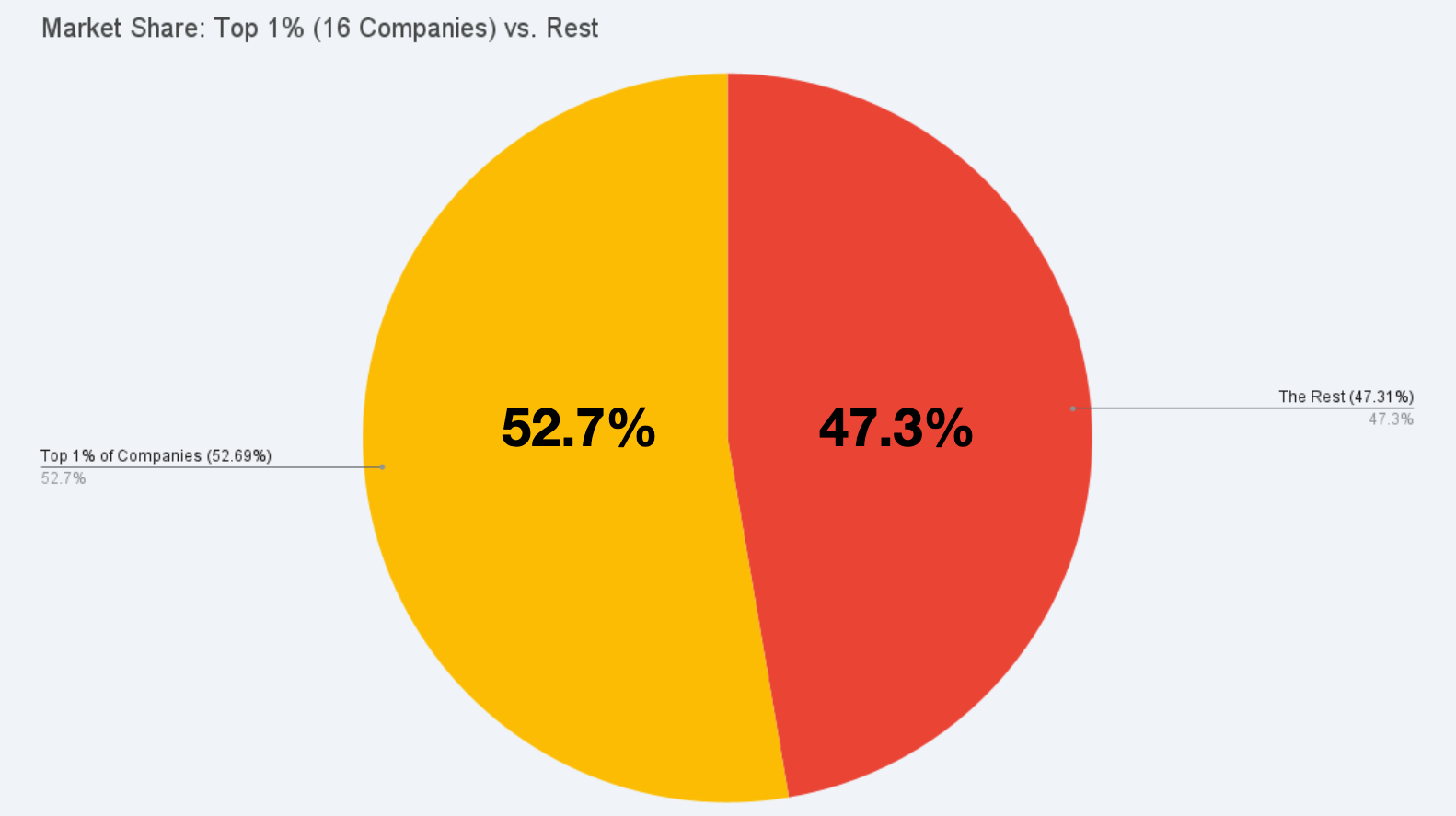
This is the market share of a large MLS with roughly 1,600 participant brokerages. The top 16 brokerage companies in that MLS controls 53% of transactions, and about the same in listings. If you move to the top 5%, or 80 companies, we're looking at 80% of the transactions in that MLS.
If those 80 companies, hell, if the top 16 companies, decide to form their own MLS... what happens to this MLS? How many agents stay subscribed to the MLS that only has 20% of the listings in market? 47% of listings?
If what Nick posits is absolutely true, and this is a business model battle and large brokerages stand to gain by screwing the MLS over and doing private listings... what is it that you think the MLS can do to stop them?
Now, here are the 2026 RealTrends top 10 brokerage by volume, and please note that #1 and #2 are now one company, since this was based on 2025 data.
| Company | Referral network | 2025 sides | 2025 volume | Private listings |
|---|---|---|---|---|
| Compass | Independent | 245,173 | $262,231,835,885 | Yes |
| Anywhere Advisors | Coldwell Banker, Corcoran, Sotheby's International Realty | 245,250 | $192,755,025,150 | Yes |
| eXp Realty | Independent | 343,091 | $155,560,436,507 | Multi-Portal Yes |
| HomeServices of America | Berkshire Hathaway HomeServices | 212,810 | $135,910,882,988 | Zillow Preview |
| The Real Brokerage Inc. | Independent | 131,047 | $65,220,758,455 | Unknown |
| Hanna Holdings | LeadingRE | 106,868 | $40,257,484,370 | Yes |
| Douglas Elliman | Independent | 21,338 | $39,761,999,463 | Yes |
| Redfin | Independent | 50,484 | $31,871,981,937 | Yes |
| Side | Independent | 28,894 | $25,774,561,660 | Zillow Preview |
| Peerage Realty Partners | Sotheby's International Realty | 24,957 | $24,805,342,163 | Yes |
And let's not forget about Keller Williams, RE/MAX, Side and United Real Estate who are all part of Zillow Preview.
Do Nick and the others truly believe that brokerages would just choose not to pursue their self-interest in order to preserve the status quo that screws them? That they would simply choose to just keep losing money or barely breaking even on 3% profit margins?
It's not a technology issue in 2026, as I have laid out previously over and over again. It's a matter of will and incentives. And if Nick is correct that the incentives are such that big brokers would kill off the MLS to make more money... then I got news for you: it's time to plan the funeral.
The only way that I see for the MLS to continue to exist is to do the one thing that all brokerages agree on today, at least on paper, at least with words and promises: cooperation. The MLS was founded as a cooperative network, and none of the big brokers want to do away with that. But they will, if they are forced to choose between doing away with cooperation on the one hand, or being a portal's bitch on the other.
The Real Bargain: Plata o Plomo
I suppose this is why I am so invested in the idea of the Cooperative MLS. Because I love the MLS, and the good people who work hard to keep them going. I think the cooperation system is what differentiates American real estate from all others. There is so much good that the MLS does that I really don't want to see it go away.
But go away it will in its current form.
Thinking about the possible aftermath of going Cooperative MLS, Nick writes:
I don’t think [going back to how it was before] is that easy. Portals will have filled the gap with their own ways of syndicating listings directly from brokerages and agents. The distribution infrastructure will have atrophied. The political will to rebuild what we just dismantled won’t be waiting for us. If Compass becomes more profitable by increasing their pre/off-MLS sales, other big brokerages are sure to follow. The MLS no longer contains a complete data set and thereby loses all authority as the single source of truth for the housing market. It’s crippled to the point that subscribers question the entire value proposition of the MLS in the first place.
Portals are already filling the gap with their own ways; what do you think Zillow Preview is?
Other big brokerages have already followed Compass. See the table above.
The MLS will not be the single source of truth because brokerages want the MLS to butt-the-fuck-out of marketing and lead-gen. And then it will be crippled to the point that subscribers will abandon it.
And again, just what is it that you think the MLS can do to stop this from happening? Another committee meeting? A Board resolution? Another tough rule and massive fines? What if brokers refuse to pay? What if they sue instead? How big do you think the average MLS's legal budget is?
The world has moved on. More and more MLSs are starting to figure things out. The real bargain, you see, is not the Faustian Bargain Nick imagines. The real bargain is plata o plomo, silver or lead.
Not Broken Yet, Just Bent
The way forward seems clear to me at least, and it is perhaps why I am passionate about preserving what can and should be preserved. There are, as far as I can tell, only three paths ahead of us:
- Public utility. Have the government take over. That may be what Nick wants in the end, but that bargain is not merely Faustian, it is straight up The Exorcist. He won't get what he wants and neither will anyone else.
- Total fracture. The current path takes us there. It is what Nick was afraid of when he wrote his first piece about the pre-market arms race leading to a thousand private MLS systems.
- Cooperative MLS. This is what I am advocating for, to preserve what is the best part of the MLS: cooperation between competitors. I simply don't see a way for that to co-exist with listing distribution as currently done via IDX and top-down rules.
Despite the past few years of bitter fighting, I don't think the relationship between brokerages – even the largest brokerages – and the MLS is broken. It's just bent. It can be bent back to shape. It just takes some give and take, and a reason to keep what we can. Just a little bit's enough.
Give up listing distribution and marketing, and keep cooperation. We all can learn to love again.
-rsh