
[Note: I have already disclosed that I have a business relationship with Compass. However, they pay for my time as a consultant, not my opinions. I bring it up again here because of the topic of this post, though all of the opinions herein are mine and mine alone. You are free to make up your own mind.]
I think any fair minded observer knows by now that I think the world of Nick Aufenkamp, who disagrees with me on quite a few areas. But I find him very reasonable and believe that he is searching for the truth as I am.
I thought I would write this not as a private email to Nick, but as a public post because I think there are a lot of people in the industry who are also searching for the truth. They're not partisans for either Zillow or for Compass; they're just trying to figure out what they think and why they think it.
However, being human, we all form beliefs. I have mine. Nick has his:
I believe the housing market the American public deserves is one that is maximally accessible, transparent, and fair. I believe Compass’s “3-Phased Marketing” strategy is a threat to the relative transparency and fairness American consumers — buyers and sellers alike — enjoy today. And, as The Kingmaker argued, I believe Compass is weaponizing MLSs to advance a corporate agenda that, at its core, is designed to benefit its shareholders over the homeowners our industry exists to serve.
(For the record, I do not think Nick is somehow in Zillow's pay just because they are flying him to the hearing. I believe him when he says he's openminded and neutral.)
I think it's great that Nick lays out his beliefs, and he is entitled to them. Because all of us are entitled to our articles of faith, which do not need justification or foundation or reasoning.
Except that a belief that has never been questioned, never been examined, is empty and not worth very much. I have had my beliefs and opinions challenged all the time – after all, I do a podcast with Greg Robertson, who is on the other side from me. One of my best friends is James Dwiggins, who is a partisan on the other side. I've had to reconsider my opinions often, and I expect to reconsider them more in the future.
What I'd like to do here is to offer that to Nick. I'm going to poke a bit at the foundation of his beliefs, to see what they're made of. I expect that many of you have similar beliefs which could withstand some examination. None of this is out of hate; if anything, it's the exact opposite. I respect Nick as I respect my readers, and I consider all of us as people trying to get to the truth.
Here we go then.
Housing Market the American Public Deserves
Nick and I have already gone back and forth on this, and he hasn't really answered all of my questions and criticisms. But the one he needs to wrestle with (at least if he wants to convince others who are not already singing in the choir) is this one from me:
I believe that bona fide buyers do have justified expectations about the kind of information they should be able to get. At the same time, I do not believe that the public at large has any reasonable expectations of the same.
He never really addressed that, but we find that he believes that the American public deserves some kind of a housing market.
I don't understand that. At all.
The public deserves a lot of things, like honesty from our politicians (hahahaha!), a justice system that doesn't treat the rich differently from the rest of us (LOL!), a food environment that isn't focused on feeding us poison (snicker!), and so on. But in what conceivable way does the public deserve a certain kind of housing market?
That's like me suggesting that I deserve a certain way to buy and sell yachts, despite my not being today, not ever having been, and not likely to ever be a buyer or seller in the yacht market.
We could and do say that everyone in America deserves to be treated fairly and not be denied a chance to participate in a marketplace... except that was never, is not now, and will never be true for every marketplace.
Because we believe in something called private property rights. Once upon a time, NAR used to care about such niceties, which is why I was such a supporter. To quote Biggie Smalls, things done changed.
If I decide to sell my watch to my kids, thereby shutting out the "public" from the opportunity to my watch, that is nobody's business but mine. It does not matter in the least bit whether that watch is super rare, super desirable, and everyone would want it. I don't have to consider "the public" in my decision.
Same with a car. A boat. An airplane. Stocks and bonds. Firearms. Literally everything I own I can decide to shut the public out. Because they have no rights and no expectations to my private property, which at the end of the day is mine to do with as I please.
Somehow, we're to believe that houses are different? Why?
Nick's argument is that housing is special somehow:
For most Americans, housing isn’t a luxury good. It’s essential. It’s shelter. And it’s the largest financial decision most families will ever make. For a marketplace this consequential to function fairly, the public needs broad, timely, reliable access to the core facts driving the market. What’s for sale. How long it’s been available. What the pricing history looks like. What comparable homes have sold for.
The overwrought emotional appeals do not justify singling out houses.
That Word Housing...
First, "housing" doesn't mean buying a house. Housing, if we're talking shelter, means rentals for over 35% of Americans. Yet, we do not see real estate agents passionately arguing for the absolute need to make sure that every single rental – including the one where the homeowner decides to rent a room in the basement with a "For Rent" sign in the window – be plastered all over the internet.
Ask yourself, homeboy, why is that?
The reason is that agents don't make enough money from rentals to care that much. Zillow doesn't get to charge 40% referral fees on rentals, because no agent would pay that for a $1,200 payday, and no landlord would agree to pay that.
In fact, most agents look at rentals as "training wheels" that newbies should do to learn how to work with live clients. If they screw up, if they make a mistake, no big deal – it's only a tiny payday. Don't believe me? Contact any top agent (your AI can recommend a few for you) in your market and ask them to help you find a rental and represent you as a fiduciary. See what the answer is.
It turns out, the "public deserves full access" side only cares if it involves the sale and purchase of a house, with the fat commission checks and large referral fees. But not really even then.
One reason I know this to be true is that there is zero pressure on anybody to make sure that New Construction is in the MLS, on portals and "transparent."
Ask yourself, homeboy, why is that?
It isn't as if new construction isn't important to buyers. In 2024, there were 680,000 new homes sold, or 15% of the holy housing market that Nick cares about so much. Yet not a word from Washington REALTORS or Zillow or anybody about how the MLS must mandate listings from all builders and spread them far and wide. No moral outrage about Pulte or Taylor Morrison hiding listings?
Sure, we get the excuses from "well, builders are actually FSBOs" to "they're not members of the MLS" to whatever else. Those are mere excuses because everyone knows that an MLS who mandates listing entry by builders would find them laughing the MLS out of their offices. Everyone knows this, which is why no one is pressuring anyone about new construction.
In fact, Zillow has a whole separate program for homebuilders. Lots of benefits. Promoted Communities, Builder Dashboard, On-site Tour Booking, etc. etc. You know what that program does not have? A Listing Access Policy. Builders can put a new home on their websites and nowhere else for as long as they want. Zillow will happily take those listings.
Ask yourself, homeboy, why is that?
Thing is, when Team General Public (which includes state REALTOR Associations in a true oddity) is out there lobbying for changes to the law... the fact that builders are left out of the requirement for "public marketing" is striking. They care about public access to all homes for sale, except for fully 15% of the housing market for sale by builders who have an entirely separate program on Zillow for them, and whose relationship with real estate agents is... rocky at best.
In fact, every single law lobbied for and passed/considered to date only applies to licensed real estate agents. A landlord listing a rental on Craigslist or only on his own website is outside of these laws. Why? FSBOs are exempt. Why? Builders are exempt. Why? If the principle is "the American public deserves a wide open housing market" then limiting the application only to licensed professionals seems extremely odd.
Ask yourself, homeboy, why is that?
It becomes difficult to escape the conclusion that what Team Random Voyeur cares about is not "housing" or even buying a house, but commissions for buyer agents and the referral fees that portals get. Tell me how I'm wrong.
Here's the thing: there's nothing wrong with caring about commissions and referral payments. Pursuit of profit is not evil in my eyes. Offering a service and getting paid should be encouraged. Just don't tell me with a straight face that what you really care about is a transparent and available housing market.
"Largest Financial Decision"
Second, the "largest financial decision most families will ever make" also fails upon examination.
If Team General Public actually gave a damn about financial struggles of American families, it makes no sense to limit said concern to just used homes they buy or sell using a real estate agent.
To the average American family, the cost of cars is no joke.
The average new car payment hit an all-time high of $772 a month in Q4 2025, and one in five new-car buyers is now paying over $1,000 a month just for the loan. Car insurance is up nearly 20% year over year. Maintenance costs have risen 33% since 2020. Auto loan delinquency rates are at their highest point since the Great Recession, with subprime borrowers hitting 60-day delinquency rates not seen since the 1990s. People are stretching loans to 84 months — SEVEN f'ing years. To pretend today that the car purchase is not a major financial decision to an average American family is tone-deaf.
So where are the calls for laws mandating the public marketing of used cars?
Health insurance? The number one cause of bankruptcy in the United States is not buying a house. It's getting sick. Where are the calls to deal with that?
But fine, let's ignore the financial burdens on the American family. The real estate industry can't solve all of the world's problems, even though NAR has opined on and acted on all sorts of non-real estate issues. Let's agree that real estate can solve real estate problems, so we only care about the "largest financial decision most families will ever make." Let us further agree that everyone from Compass to Zillow agrees on that statement.
We can then talk about the word "most."
There are wealthy families for whom buying or selling a house is not the largest financial decision they'll make.
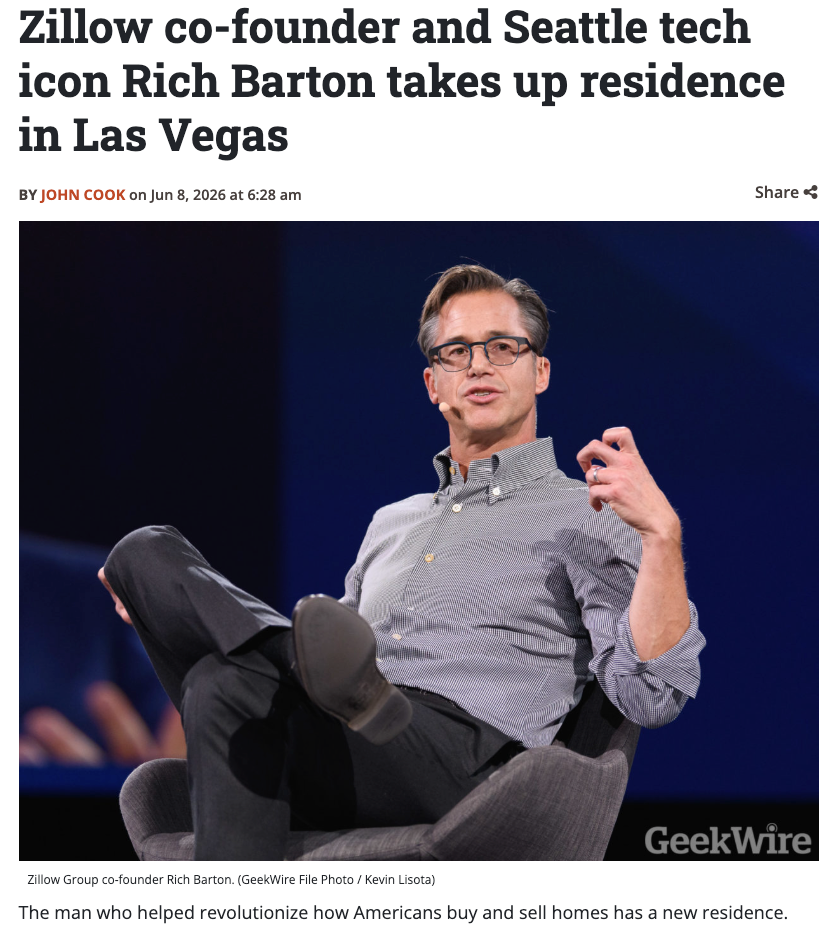
I will bet my own house that whatever home Rich Barton bought in Las Vegas (Welcome to Las Vegas, Rich!) was not the single biggest financial decision for the Barton family.
So... is there a luxury exception to all this forcing rules down our throats that I'm not aware of? Does ZLAS not apply to the top 1% of homes by price in a given market? Oh, it does! What's the justification for that again?
Do these state laws being passed have an exception for luxury properties? No?
It's as if the rhetoric doesn't match the reality of what is happening.
Ask yourself, homeboy, why is that?
Who Is Weaponizing What?
Then we have this:
And, as The Kingmaker argued, I believe Compass is weaponizing MLSs to advance a corporate agenda that, at its core, is designed to benefit its shareholders over the homeowners our industry exists to serve.
Since we're talking about Zillow v. MRED, the hearing that Nick will be heading to, I can't help but refer to my writeup of that lawsuit. Let us review the facts:
- Zillow joined MRED as a participant while MRED was operating an internal PLN.
- MRED was doing private listings long before Compass was a major presence in Chicago.
- MRED's private network was not a secret and its rules were clear. One possible consequence for violating MRED's rules was losing the data feed.
- Zillow knew those rules and agreed to abide by them.
- Zillow dutifully displayed all of the MRED PLN listings on its website when those went to Active.
- Until NAR weakened CCP, at which point Zillow decided to step in with ZLAS.
- And now Zillow wants MRED to back down, because Zillow changed their mind about the rules.
So... who is weaponizing what again?
Legally, the entire lawsuit turns on whether MRED changed its rules or merely clarified what is meant by "objective criteria, including but not limited to factors such as … type of listing." If the former, Zillow has a case; if the latter, there is no case.
Nick believes that the real question in this lawsuit is "whether a single brokerage can turn the cooperative the entire industry depends on into a weapon aimed at everyone else." That does not fit the facts of the case, nor the reality of this lawsuit.
The real question in this lawsuit is whether an MLS can enforce its longstanding rules on a participant who agreed to abide by them or not. Since the answer is an obvious Yes, the sub-question and the heart of the lawsuit is whether MRED changed its rules in illegal coordination with Compass, or merely clarified the rules after a previously inconceivable turn of events.
The Fake Morality Tale
Finally we have this, which comes from The Kingmaker article he linked to:
My position then is my position now: if I’m a homeseller in Chicagoland, I am pissed. I’m angry that, because of some corporate fight I had no part in, my home is no longer showing up on the largest real estate website in the country, and that I’m missing out on potential buyers as a result.
Literally the only way your home is no longer showing up on Zillow is if you the home seller approved the 3PM strategy that your Compass agent recommended. I'm pissed that you did what I told you to do! doesn't have quite the ring that blaming some corporate fight does, does it?
So what are we even talking about here?
And if I’m an agent, I’m also upset, because explaining why my clients are getting fewer eyeballs today than they got just a few days ago is not the position I want to be in.
Again, literally the only way this happens is if your client told you to keep their home off of Active. What explanation is necessary, if you've done your duty to inform the client of the risks vs. rewards?
Why Nick and Zillow are so concerned about a seller who told his agent to do the 3PM strategy, knowing the risks involved, is unexplained. Instead, we get treated to moral sermons about consumers caught unaware by evil real estate agents. This is, to put it mildly, a fictional scenario. To put it correctly, it's gaslighting.
(By the way, if your objection is that the agent is pulling the wool over the seller's eyes, then read what I believe about informed consent. Note that the solution to agents lying to clients does not involve new state laws or lawsuits against the MLS; it involves suing the agent for breach of fiduciary duty.)
The question I can't help asking is, why does your position rely upon fake morality tales? An agent recommending a strategy to the client, and the client giving informed consent is the true reality. Doesn't your moral principle apply to actual reality, or does it only apply to made-up moral panic?
Ask yourself, homeboy, why is that?
Conclusion
Let me wrap up.
I've already spoken to Nick before publication; he knows where I'm coming from and why I'm offering these critiques and questions. But you all should know as well.
No one in this drama is fighting to save souls. No one is pushing an argument to bring about a more perfect union, a more just society, or for the public good. Everybody is operating a business and wants to keep a business model, or challenge a competitor, or whatever it is that businesses do every single day. Every single agent with an opinion is still pursuing commercial interests as well, because no real estate agent I know of does pro bono work. And that's all great, because the real estate industry is not the child-saving industry. It's making money from buying, selling, renting and leasing housing units.
There are real issues here for the industry. They might have far-reaching consequences. But what I'm looking to do on these pages is to have an open and honest examination of those issues and those consequences. I do not want to be manipulated, and I don't want to be gaslit. I don't want highfalutin' emotional appeals to obscure the reality of the commercial debate underneath.
When there are such differences of opinions, of beliefs, of pursuits... I favor the free market as the mechanism to settle the differences. Nothing has proven to be better or more effective than the free market and open competition to determine what the best way forward is.
Nick concludes his post with this:
At the deepest level, that’s not a Zillow problem or even a Compass problem. That’s a who-writes-the-rules-and-who-do-they-serve problem. And it’s the same question I’ve been circling for months — now headed, for the first time, into a courtroom.
For Nick, the core important question is who writes the rules and who do they serve. I agree to an extent. Thing is, the answer to that question is already clear despite being obscured by all the emotional manipulation.
The MLS writes the rules. They serve the brokerages who make up the cooperative and who put all the listings into the MLS. The MLS should be reformed, but as a B2B cooperate created by, for, and of brokerages, it is only the brokerages themselves who can decide what to do about it. Not the general public. Not portals. Not tech companies.
Now, thanks to lobbying by Team Anybody With a Phone, some state governments write the rules. They serve nobody but the lobbyists, since the holes are not merely holes but giant gaping exclusions for entire industries (builders? corporate landlords?). And like most laws, they make everything worse, including not serving the lobbyists. Yay, government!
Let me conclude with my core important question, to give you something to critique. I understand that society and marketplaces and MLSs and data distribution need rules to function. As much as I am an anarchist at heart, I recognize that rules are necessary in a civilized society. My core question is: do those rules tend to favor free market and open competition, or stymie them?
And if the rules hamper free market and open competition, ask yourself homeboy, why is that?
-rsh